
Holidays and Holiday Homes: Interview with Axel Hacke
A conversation about the experiences and challenges of owning a holiday home, the dimension of vacation beyond the mere “recreational setting” and the happiness of harvesting olives.
We have been eagerly awaiting the new book “Ein Haus für viele Sommer” (A House for many Summers) by the German author and columnist Axel Hacke, which was published on March 8.
Using a mountain village on an Italian island as an example and from years of personal experience, he explores the topics of holidays and holiday homes as well as the relationship between (long-term) guests and locals.
In his new book, he tells of his very personal holiday adventure in a multi-faceted way, including the difficult art of “dolce far niente”.
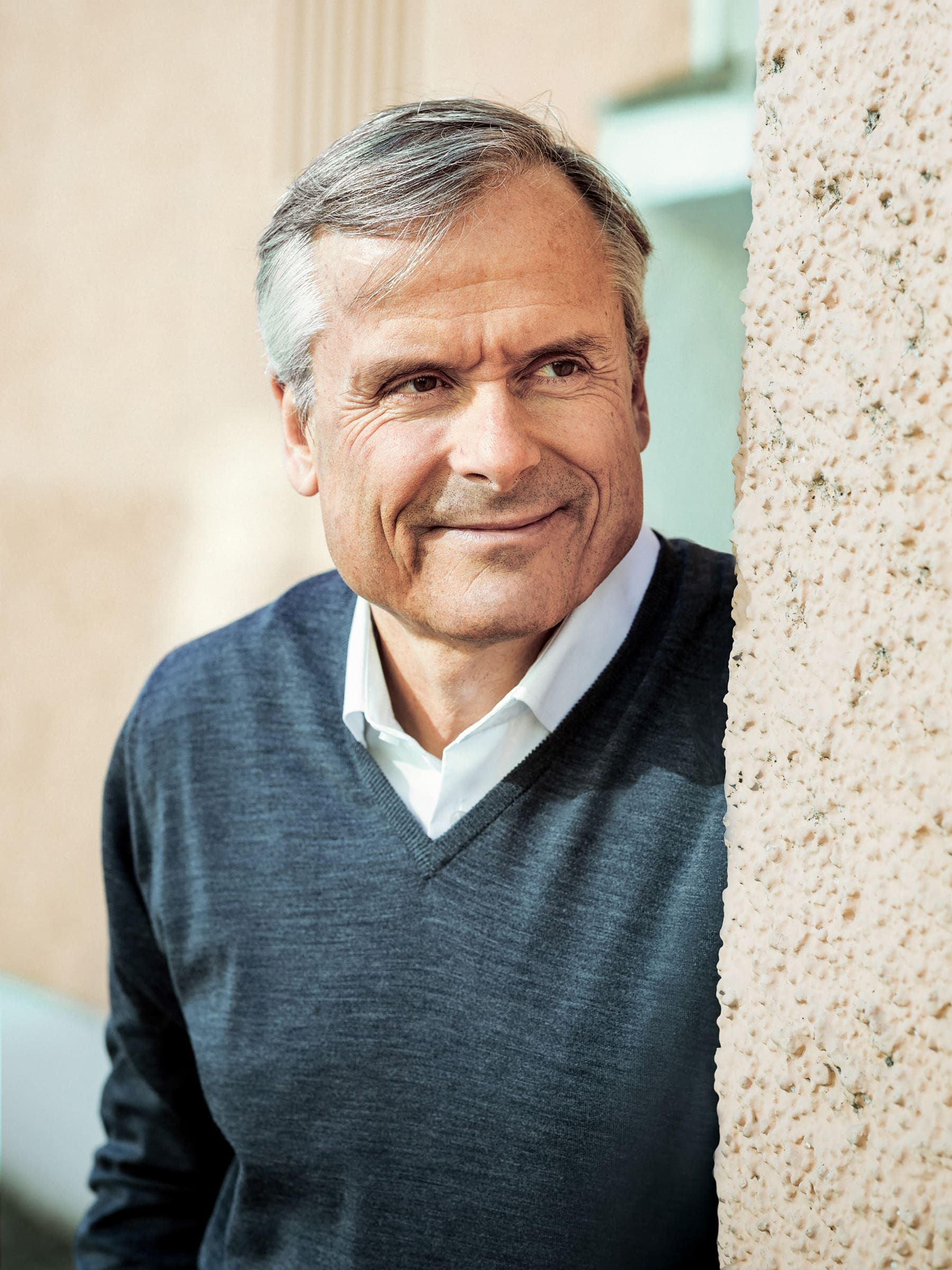
In an amusing, always precise, sometimes also thoughtful style, Axel Hacke describes the experiences and challenges of one’s own holiday home away from home; but even more, he conveys what happens when we stop seeing ourselves merely as a passive part of a “recreational setting”.
Mr. Hacke, in “Ein Haus für viele Sommer” you allow your readers to look over your shoulder as you go on holiday. Although “taking a holiday” is perhaps the wrong way of putting it…. after all, you are the owner of a holiday home. Or, as you yourself write at one point: The thought of “holidays away from holidays” has over the years come up from time to time. But you obviously have no regrets?
Axel Hacke: No, actually never. We sometimes despaired when we arrived and discovered that rain had poured into the house, that for the time being it was uninhabitable, and we had to look for a hotel. But through the hotel we met new people, made friends with the owners, are still allowed to use the pool there, and our youngest daughter learned to swim there. So: Out of many a crisis, something beautiful and new has always emerged.
But one thing is clear: Holidays in an old house like this are different from holidays in a resort; more strenuous, but also much more fulfilling. And it’s not really just about holidays. An old house like this is not just a holiday home, it’s too complicated and difficult for that. It’s about something else, more like a task.
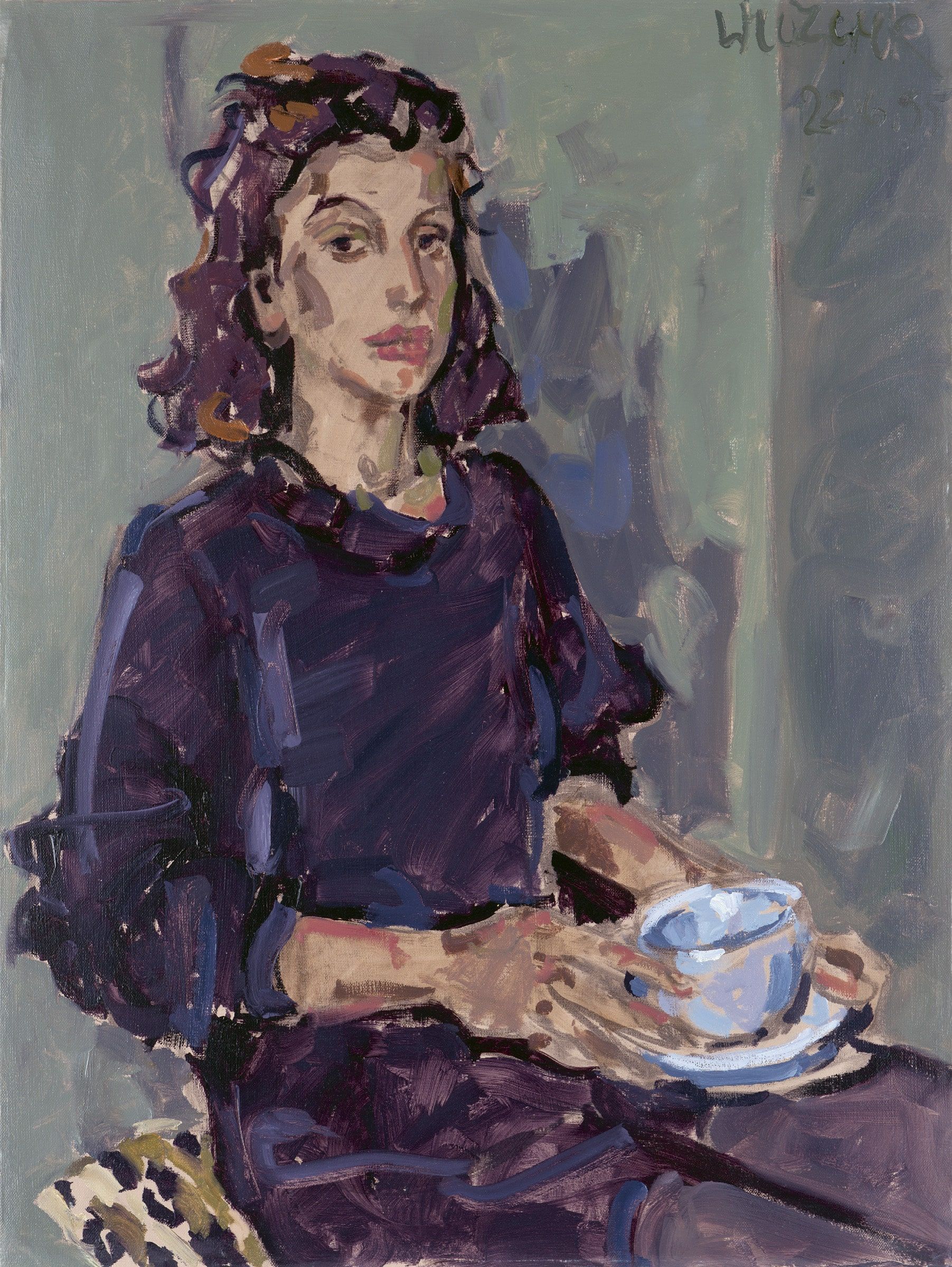
Oil on canvas. Foto: Andreas Pauly
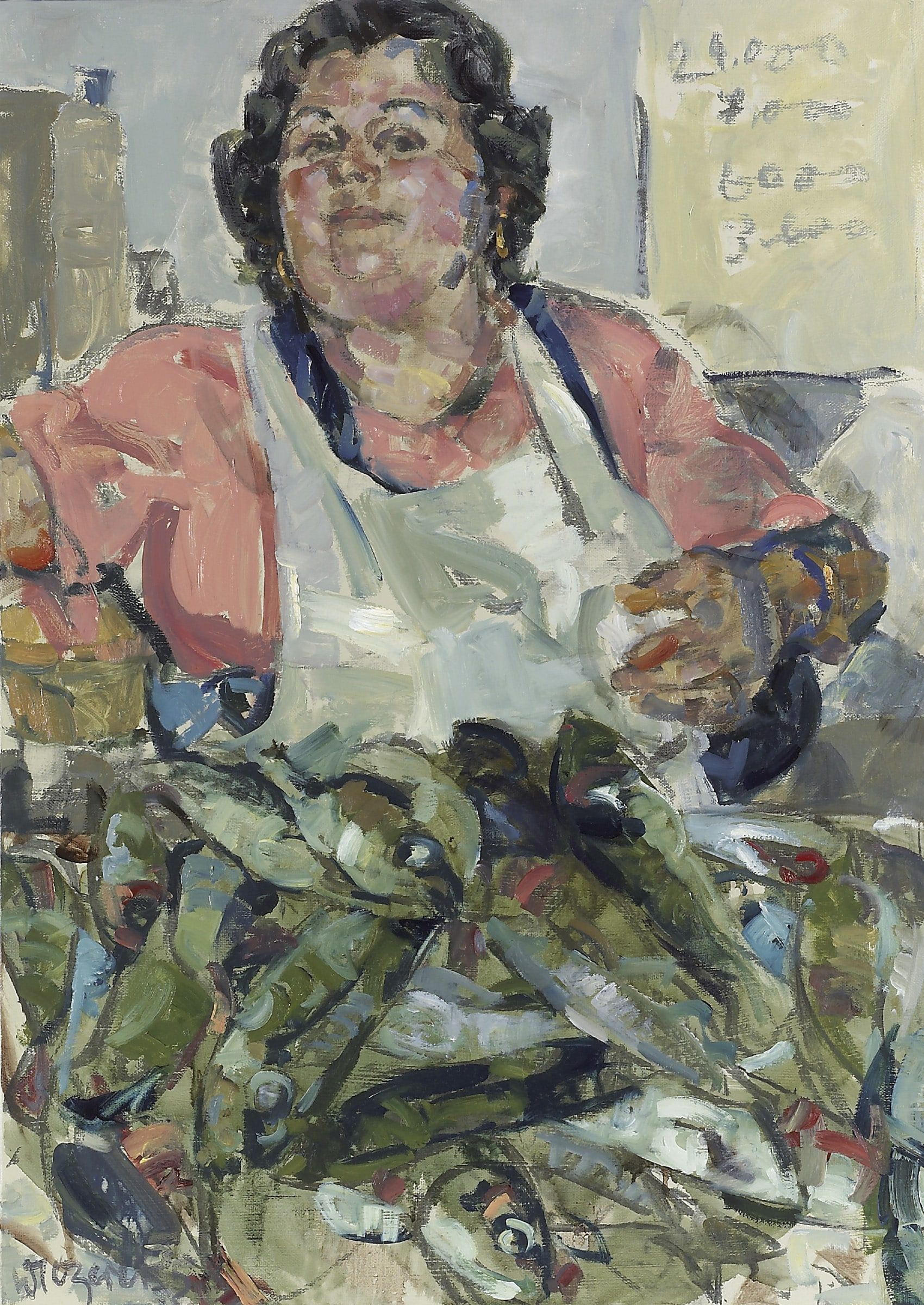
Oil on canvas. Foto: Hans Günter Numberger
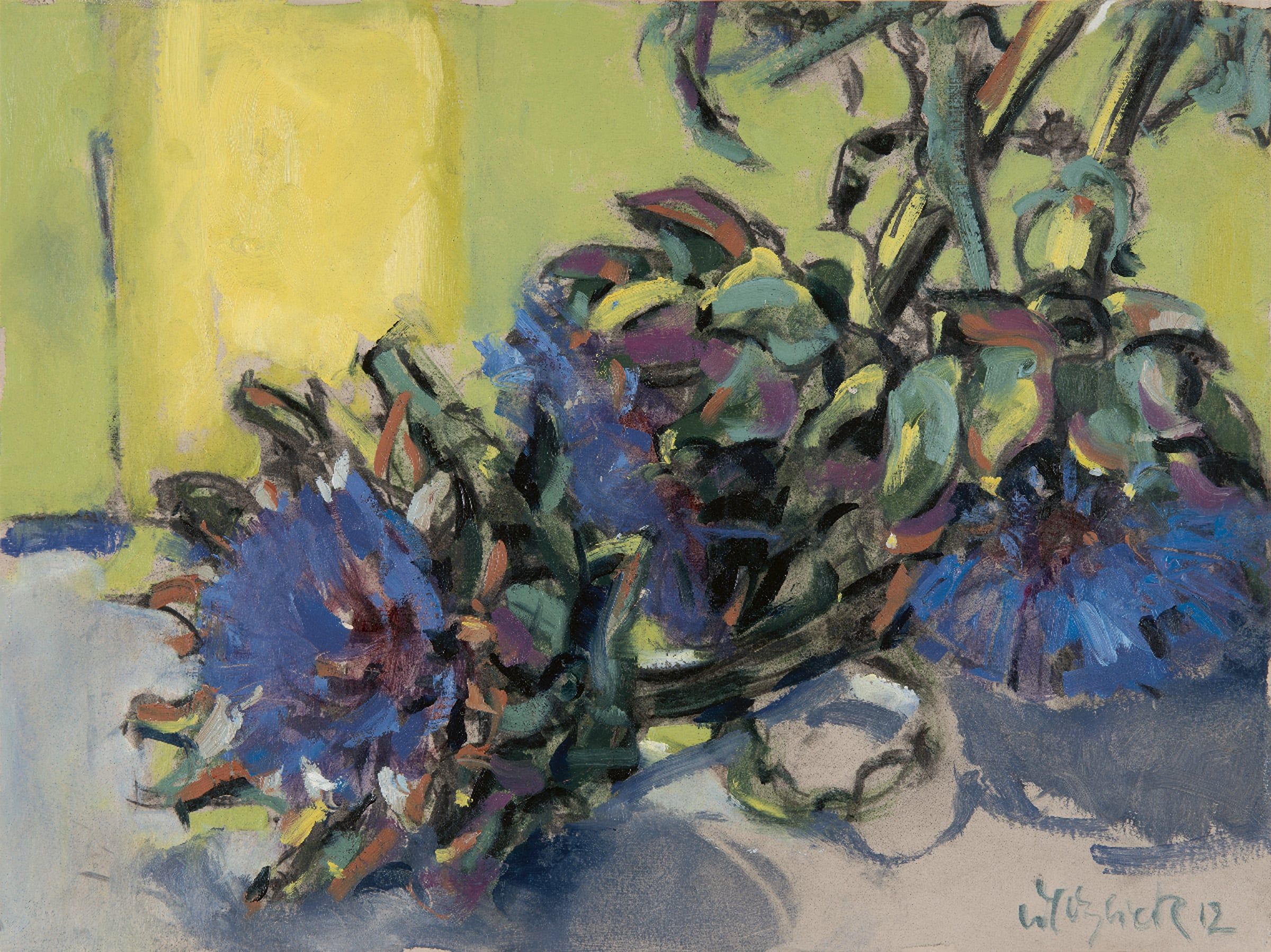
Oil on paper on cardboard. Foto: Andreas Pauly
In the epilogue to the book, you state that the Torre – the holiday home that has been in the family for decades – unexpectedly became an important part of your life. You also explicitly thank your wife there; because only through her have you learned to understand the place itself, where you initially only wanted to spend your holidays. So, in retrospect, are the respectful treatment of places – their people and cultures equally – and the deep immersion the true results of your decades-long approach?
Axel Hacke: That is, after all, the true underlying theme of the book. At the beginning, I wanted to go on holiday as usual because I knew nothing else. But through my wife, who had been coming here since she was a child and practically grew up in the village, I realised the dimension of this: that through the house and the village and the language, you get a completely different view of your own life. It’s somewhat different to a standard holiday, it’s the discovery of another dimension of life.
And of course, you soon see the depths of the history of the place. It is then no longer just a backdrop for one’s own recreation, but much more. I believe that respect for the place is not merely a result of our time in the village, but on the contrary the prerequisite for it. If you don’t have this respect, you can still have a house there. But you won’t really understand anything, you won’t experience even a quarter of what you could experience.
I guess you could say that you have put down roots there over the decades, found a kind of second home. What do concepts like being settled and home mean to you?
Axel Hacke: Well, I am a very loyal person, in general. I’ve been married to the same woman for more than thirty years, I have had the same publisher, Antje Kunstmann, since 1990, I’ve lived in the same apartment for 28 years, I’ve had the same agent for 25 years, I’ve written columns in the magazine of the Süddeutsche Zeitung for thirty years. And I’ve been going to the same village in Italy for thirty years. I can’t help it. I’m interested in what develops in the depths of a relationship, not on the surface.
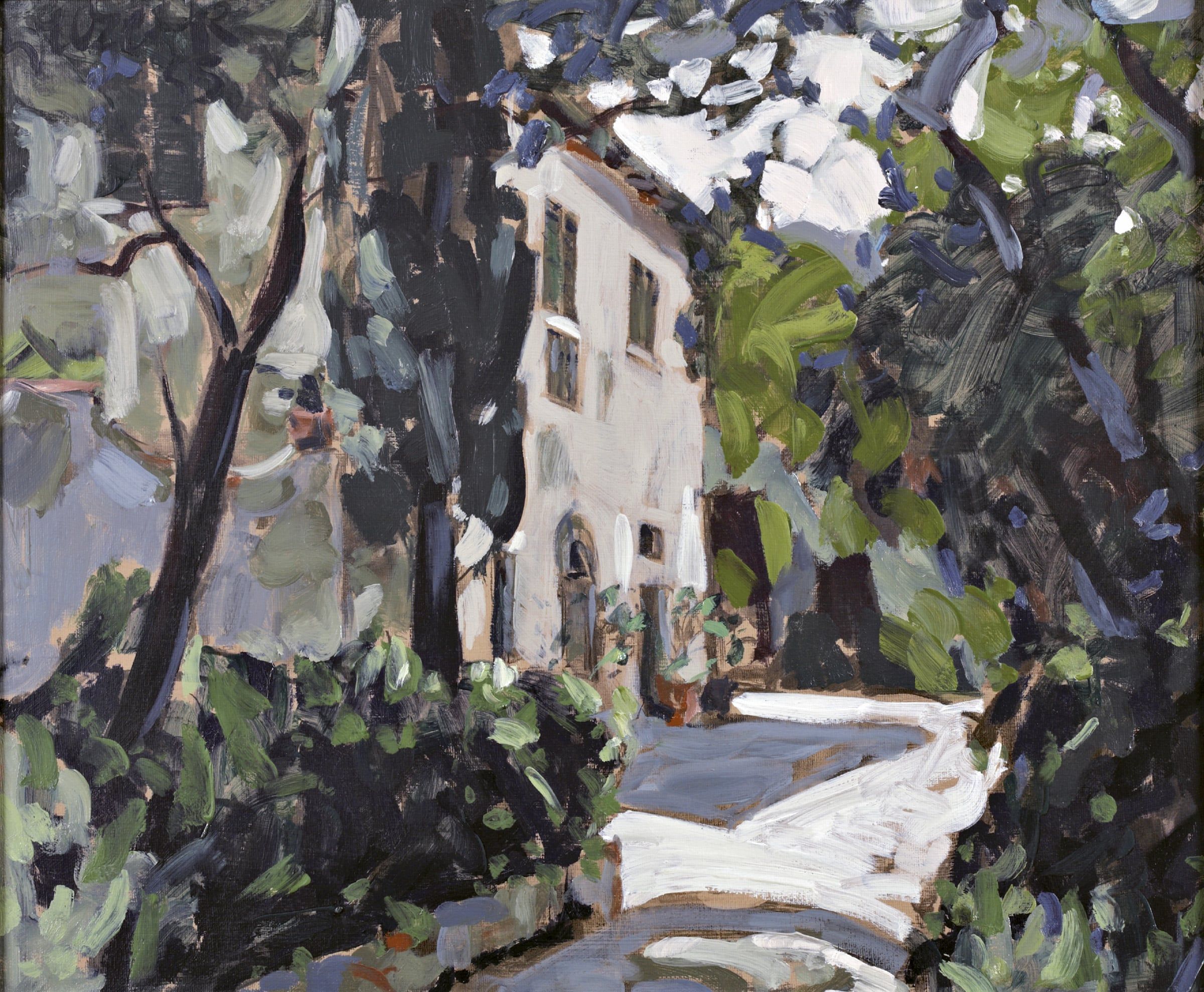
Oil on canvas. Foto: Hans Günter Numberger
At one point in your book, you wonder whether you would really have seen the whole world if you hadn’t seen the village. In other words, if you hadn’t been “bound” by chance and love to exactly this one magical place in the long term. Then you go on: “What you experience is always less than what you missed”.
If I have correctly understood it, is this a suggestion to the readership, that we define our supposed happiness far too often in terms of quantity? Your assessment of “doing nothing” still resonates with me here…. while on holiday, many travellers would simply continue the restlessness of their tightly scheduled working day, only in a different form, as you note.
Axel Hacke: We don’t want to miss anything because we are inundated with new opportunities day after day. We want to have everything and sometimes forget what we have and what we should perhaps be dealing with in a more meaningful way, instead of always accumulating more, always looking for new kicks.
A week in the Maldives doesn’t do much for me. What I experience there I can probably also read about or have someone tell me about. But if I go to a certain village for decades, then I get to know the people there, their stories, their way of looking at life. I also get to know the hardships of everyday life in another country through a house of my own, even if that is sometimes a nuisance. And that makes my life much richer than one or two weeks in a resort somewhere.
Hypothetically, since you are not entirely free in your choice of holiday: What places, what kind of holiday would have suited you?
Axel Hacke: Well, I’m a bit older now, my youngest daughter has also graduated from high school and is leaving home. We no longer take holidays with small children, at most with the grandchildren, and that will perhaps mean that on the one hand we will spend even more time in our house. But on the other hand, we can also just drive around for a few weeks in Italy, France, the world. And that’s what we’ll do. Is that a holiday then? I don’t know. I’m a writer, I always have my work with me, I often sit in the hotel in the morning and write. For me, holidays and work are not completely separate.
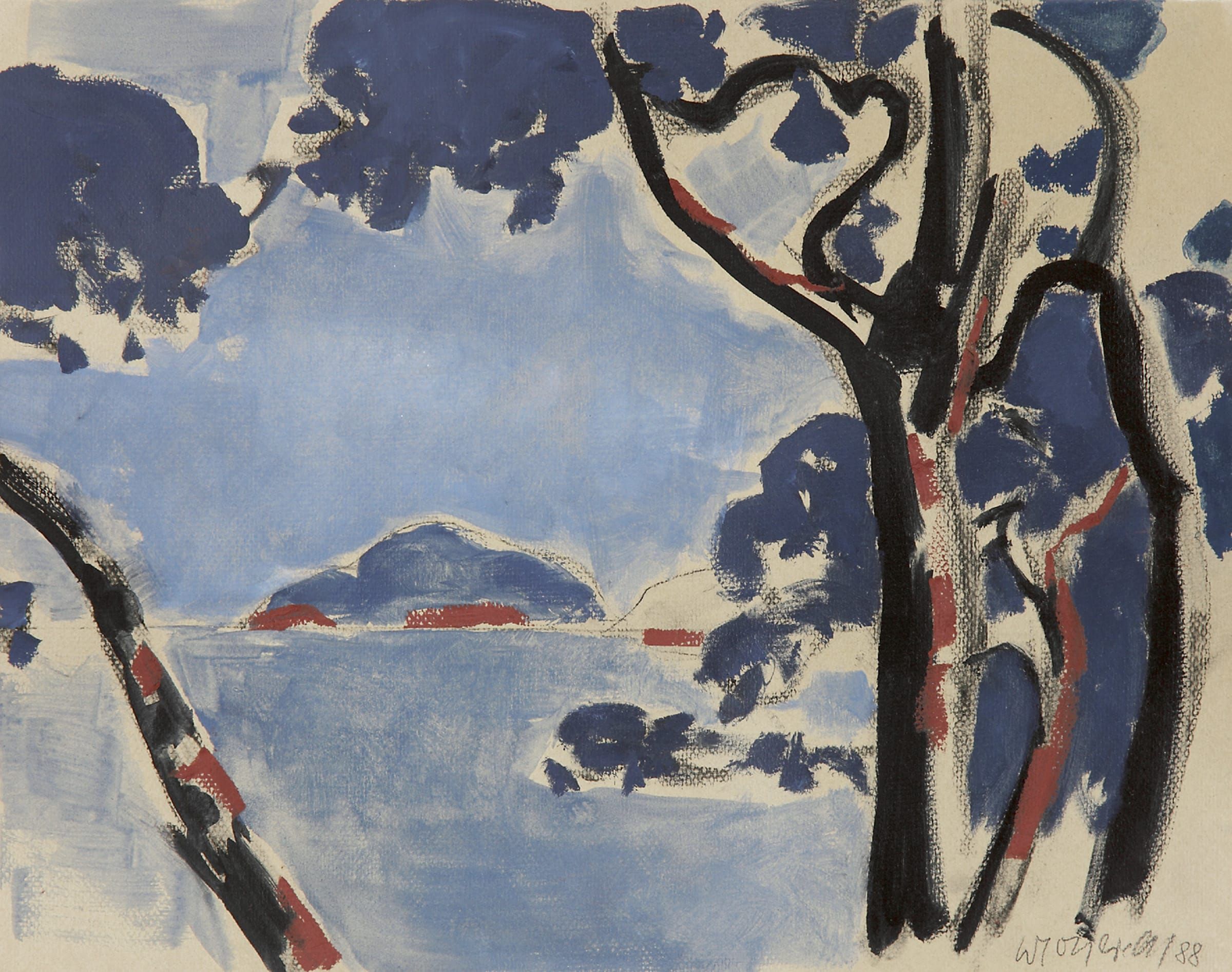
Oil on paper. Foto: Hans Günter Numberger
If you dare to make a prediction about how “unbridled tourism” will develop in times of sustainability and climate discussions – what hope do you see?
Axel Hacke: I don’t know, I’m not a tourism expert, not good at forecasts and rather a pessimist anyway. You see what’s happening in Venice, for example, nothing has improved there, basically it’s a tragedy: this kind of tourism where people don’t really want to know anything, aren’t interested in anything deeper than taking a selfie in front of San Marco. That may sound pompous, but what can you do? For many it is certainly a great experience, but it also destroys so much.
Greed is always at the top of the list; how can you fight it? And how can you blame the people who live off it? Not everyone can have a holiday home somewhere – or if they do, what does that lead to? There are villages in the south that are dead in winter, there are no more inhabitants, everything is empty because people only come to live in their houses at weekends or on holiday. And is it really so different on Sylt?
What is the significance of architecture in your life? Are there buildings that have amazed you and made a lasting impression?
Axel Hacke: Architecture already plays an important role in our family. My father-in-law is an architect, as is my sister-in-law and my eldest son. My wife is not, but she still knows a great deal about it and has a tremendous feeling for it. There’s a lot of talk in the family about it; of all of them, I’m the one with the least idea. I didn’t grow up with it either; my upbringing was different, more lower middle-class in its entire view of the world. And I have never built a house myself; in Munich I live in a rented apartment.
But I have learned to allow myself to be captured by the magic of certain spaces, by the Gothic cathedrals in France, by the ingenious staircase of the Alte Pinakothek in Munich, by the room in the Brandhorst Museum in Munich where Cy Twombly’s Lepanto cycle hangs. And of urban spaces like the enchanting piazza in front of Syracuse Cathedral or the Piazza Navona in Rome. The fact that people can think, imagine and then create such things often blows my mind.
And regarding your own holiday home, how well can you live in something that is not perfect and has evolved?
Axel Hacke: It’s great, even if sometimes exhausting. We have cursed a lot, but ultimately such an old house with its secrets, its history, the uncertainties and simply also the aura is something enormously stimulating to the imagination. The old house is not just a house, it is a kind of family member for all of us, a strange old uncle, whom everyone loves and who has a few age-related weaknesses that can be troublesome. But all that is great for a writer, of course.
Since you have certainly seen a number of hotels on your reading tours over many years: Are there things that are indispensable there from your point of view? Or circumstances that drive you completely mad?
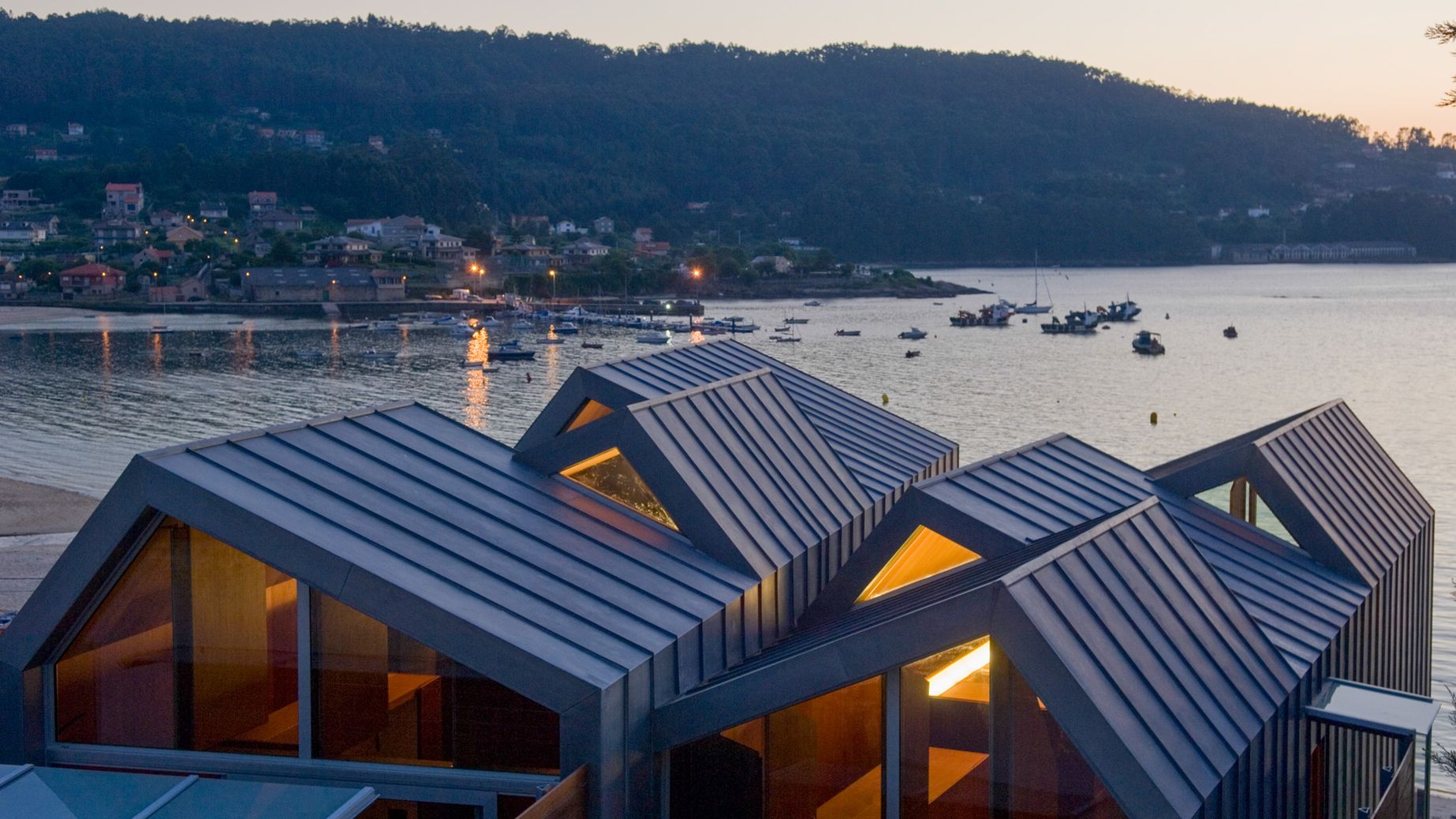
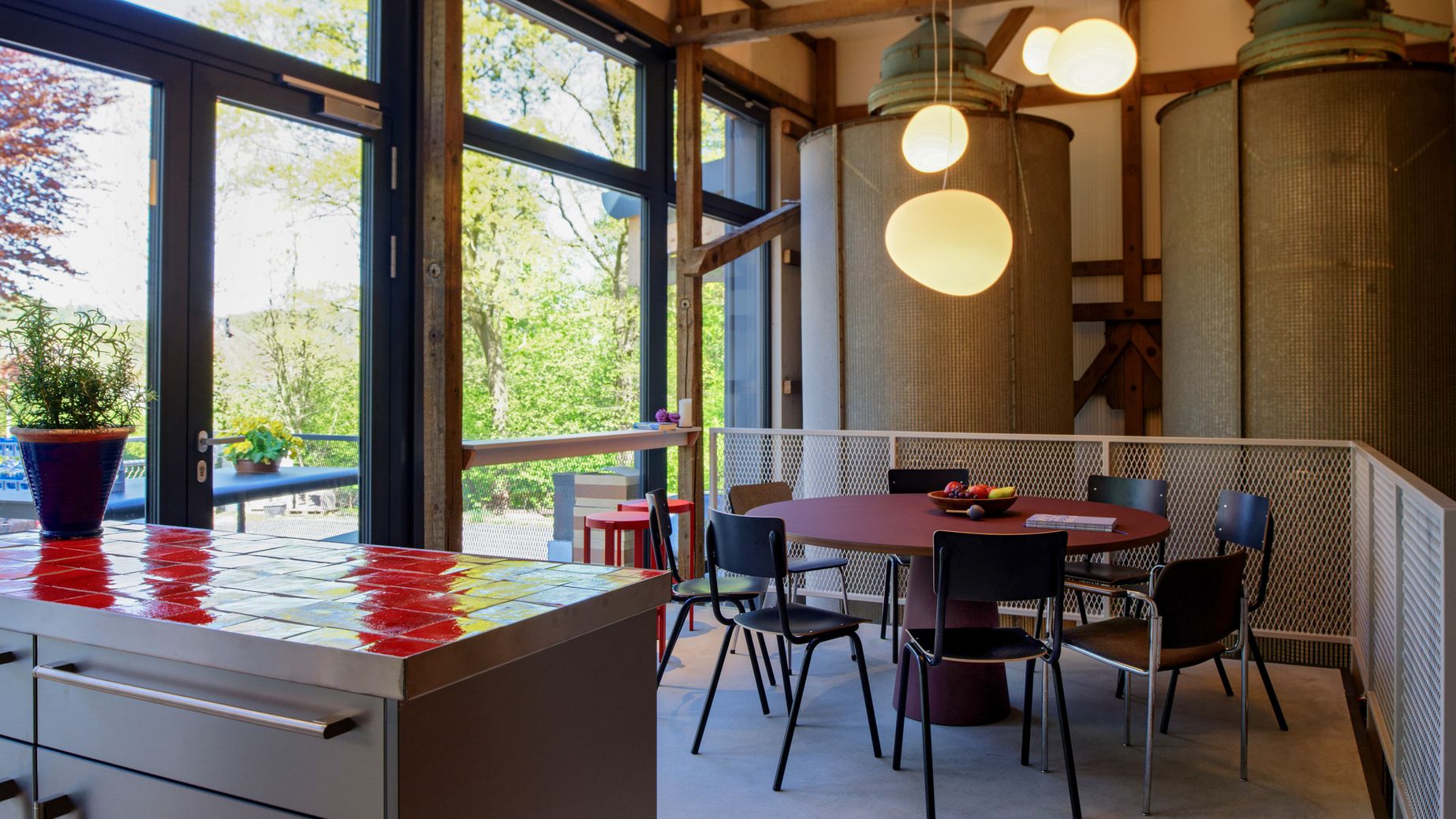
Axel Hacke: I actually love hotels, and I also like the luxury there. I like the grand hotels that have a history, the Parkhotel in Bremen, the Europäischer Hof in Heidelberg, the Nassauer Hof in Wiesbaden, but also newly conceived ones like the Speicher 7 in Mannheim, where an exceptional hotel has been created in an old harbour warehouse. What really disappoints me time and again is how utterly soulless the expensive luxury hotels that belong to the big chains are. I’ve been there maybe twenty times, and when I check in for the 21st time I am asked again by the receptionist if I have ever stayed here before.
You write in “Ein Haus für viele Sommer” that you are certain that as a non-local you will never become part of the place. That sounds realistic. And yet a little sad. A little later you take us, the readers, with you to your first olive harvest and share with us the euphoric feelings it generates – despite all the hard work. Can one say that these experiences could be symbolic of the ups and downs of a “holidaying” holiday homeowner?
Axel Hacke: No, I don’t think it’s sad. It would in fact be rather bad if you thought you were becoming a part of the place like a local. That is hardly possible, and why should it be? I know people who like to suggest that to themselves, always telling you how well they know the mayor, “Ah Gianni…, yesterday he was telling me …” That is a bit silly. The interesting thing about our village is the complexity of the relationships, the old locals who only know their village, the young people who have now seen the whole world, the tourists – and then people like us who also belong to the village, but in a different way.
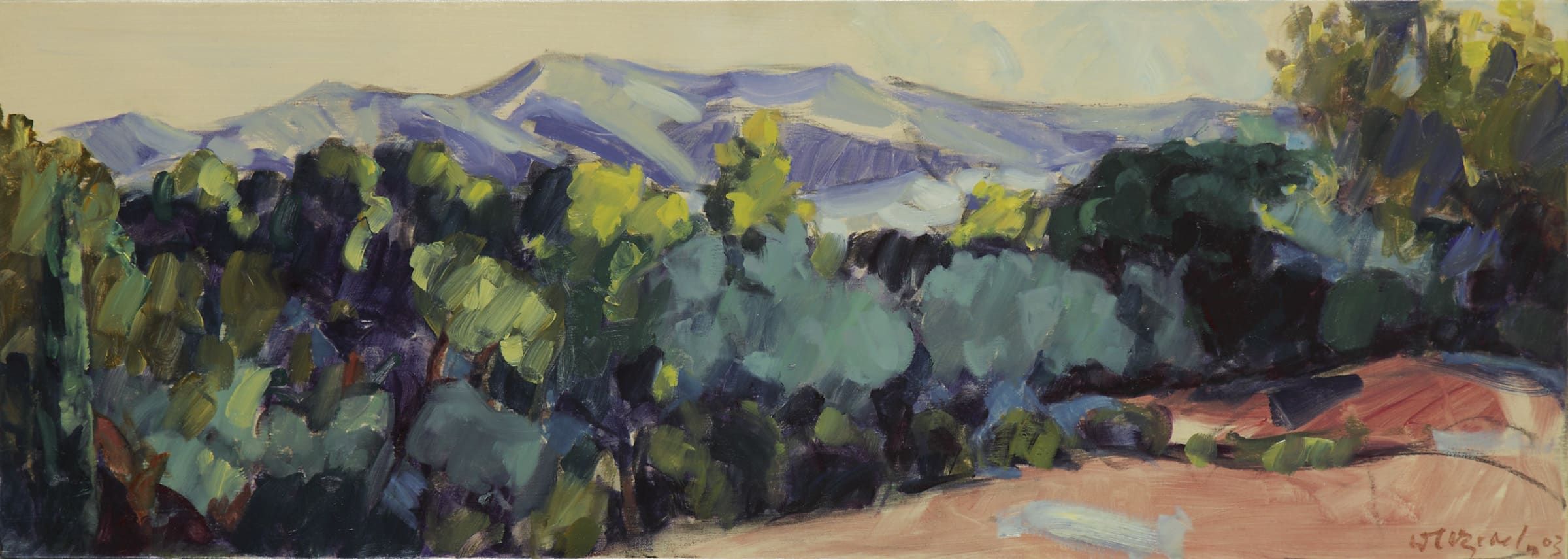
Oil on canvas. Foto: Hans Günter Numberger
In Italy, too, I am who I usually am, and sometimes a little distance is perhaps not a bad thing. The olive harvest – with this an old dream has come true. When I was a child, I always spent my summer holidays in Westphalia on my godfather’s farm. Since then, in a corner of my heart I’ve always wanted to be in the countryside and be able to harvest something. It could have been cherries in Chiemgau or apples on the edge of the Elm, a range of hills near Braunschweig, where I come from. But olives in Italy are just so much nicer.
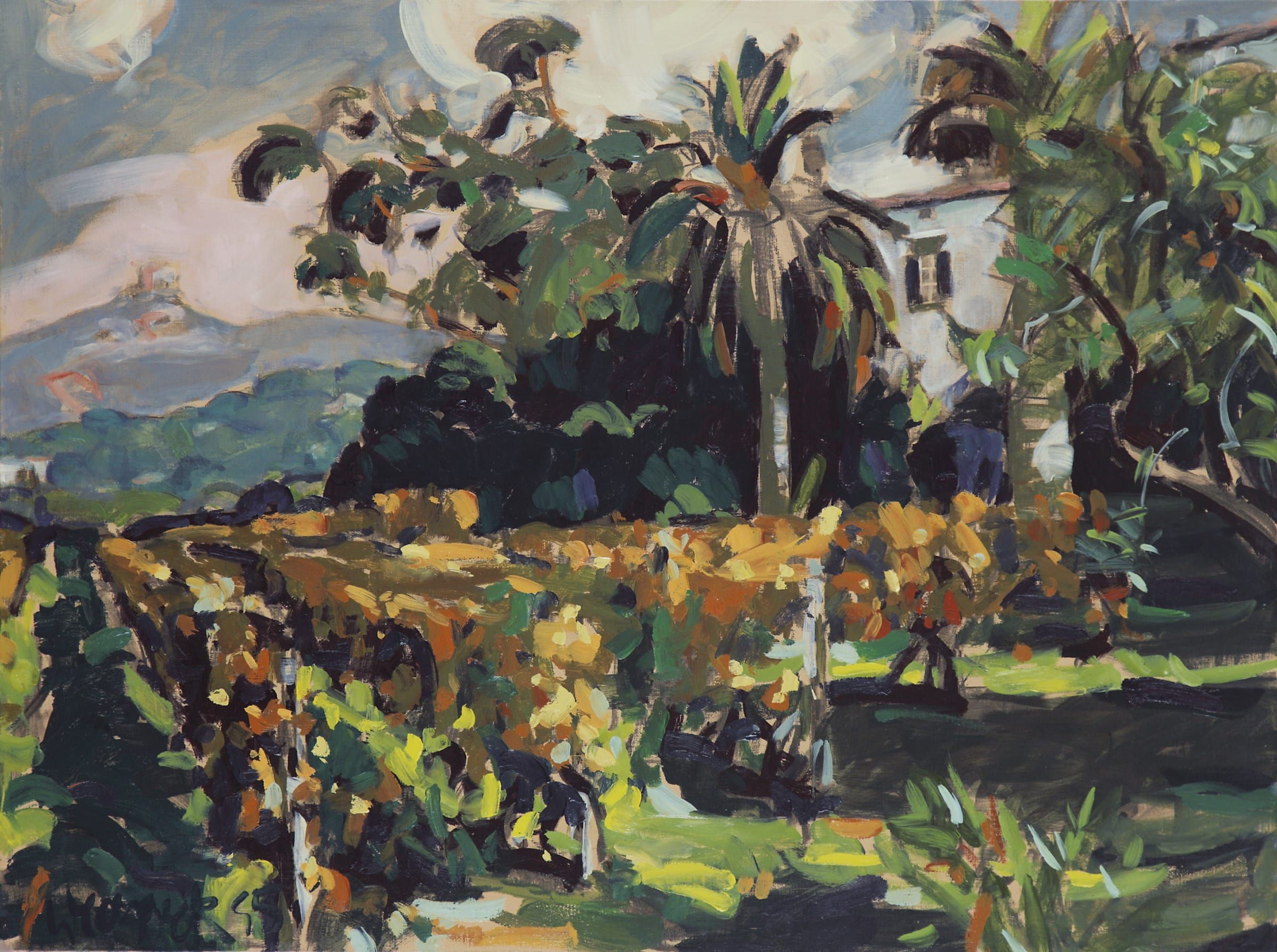
Oil on canvas. Foto: Hans Günter Numberger
Have you made any decisions in connection with your holiday property that you would strongly advise potential holiday homeowners against? Or asked the other way round:
In your opinion, what definite incentives are there for taking the risk of owning a holiday home – despite all possible adversities and the initial naivety of an amateur?
Axel Hacke: You just have to know what you’re doing. You say quite rightly that it is a risk, and for that you have to make a conscious decision, for an adventure, for something that cannot be completely planned, for something that will have an impact on your own life, not only for three weeks, but possibly for decades, perhaps forever.
A holiday home is different to a hotel, but that’s a given anyway, it’s banal to say that. You have to really want it, you have to love not only the house but also the place, you should learn the language, be really interested in the people there and want to understand something. You need the respect and curiosity for something different that will stay with you, at a deeper level of understanding, but which will enrich you enormously. And you should know that it always costs more money than you thought at the beginning. And also, it means more work. Both, actually.
I didn’t know what I was getting into, by the way. After all, I didn’t buy the house, I never decided to buy it. I just fell in love with a woman whose father had the house, and now we have it. There was no other way, one day it was simply part of my life. The old house is a family member, as I said.
Axel Hacke lives in Munich as a writer and columnist for the Süddeutsche Zeitung magazine. He is one of Germany’s best-known authors; his books have been translated into numerous languages.
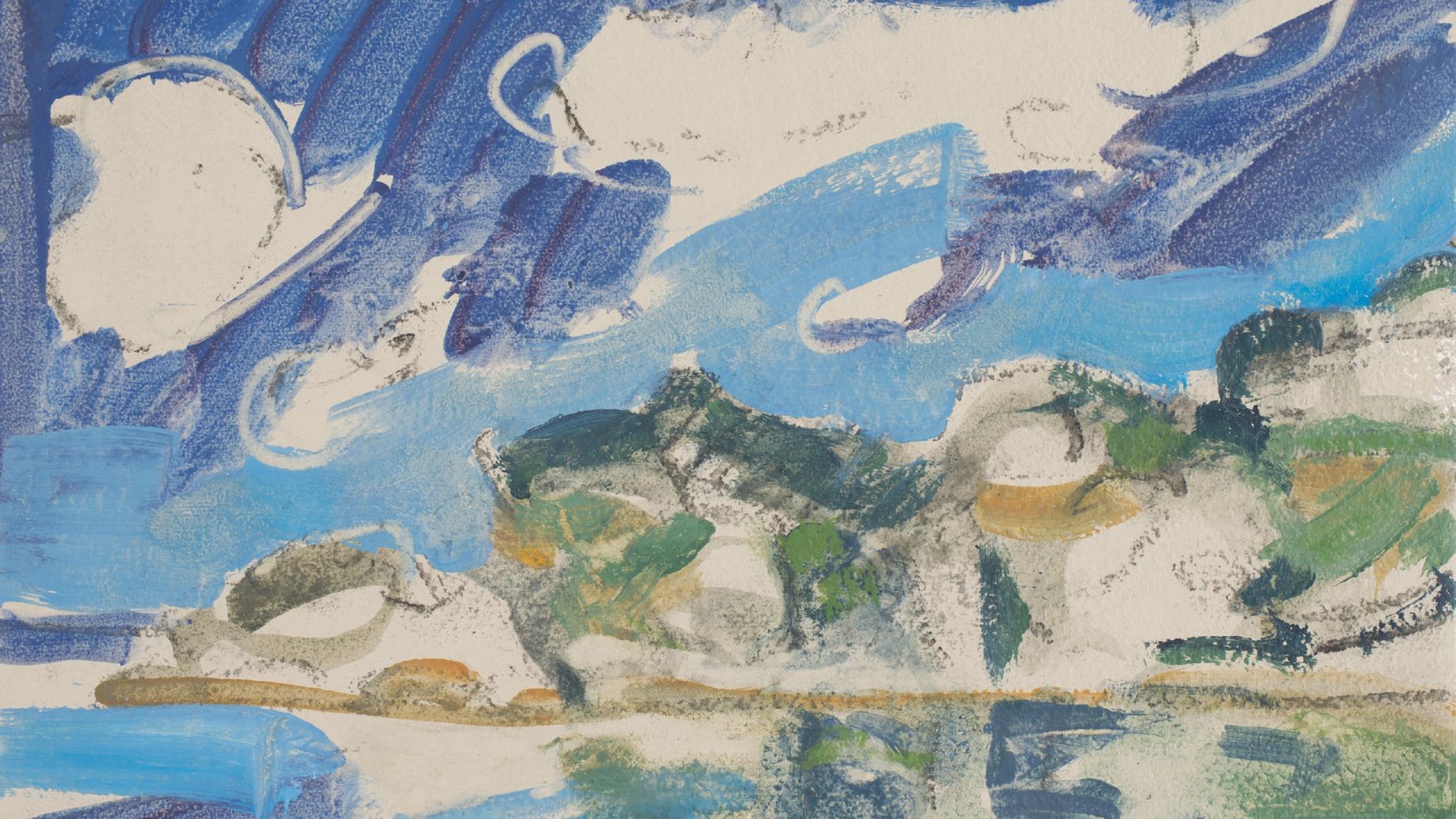
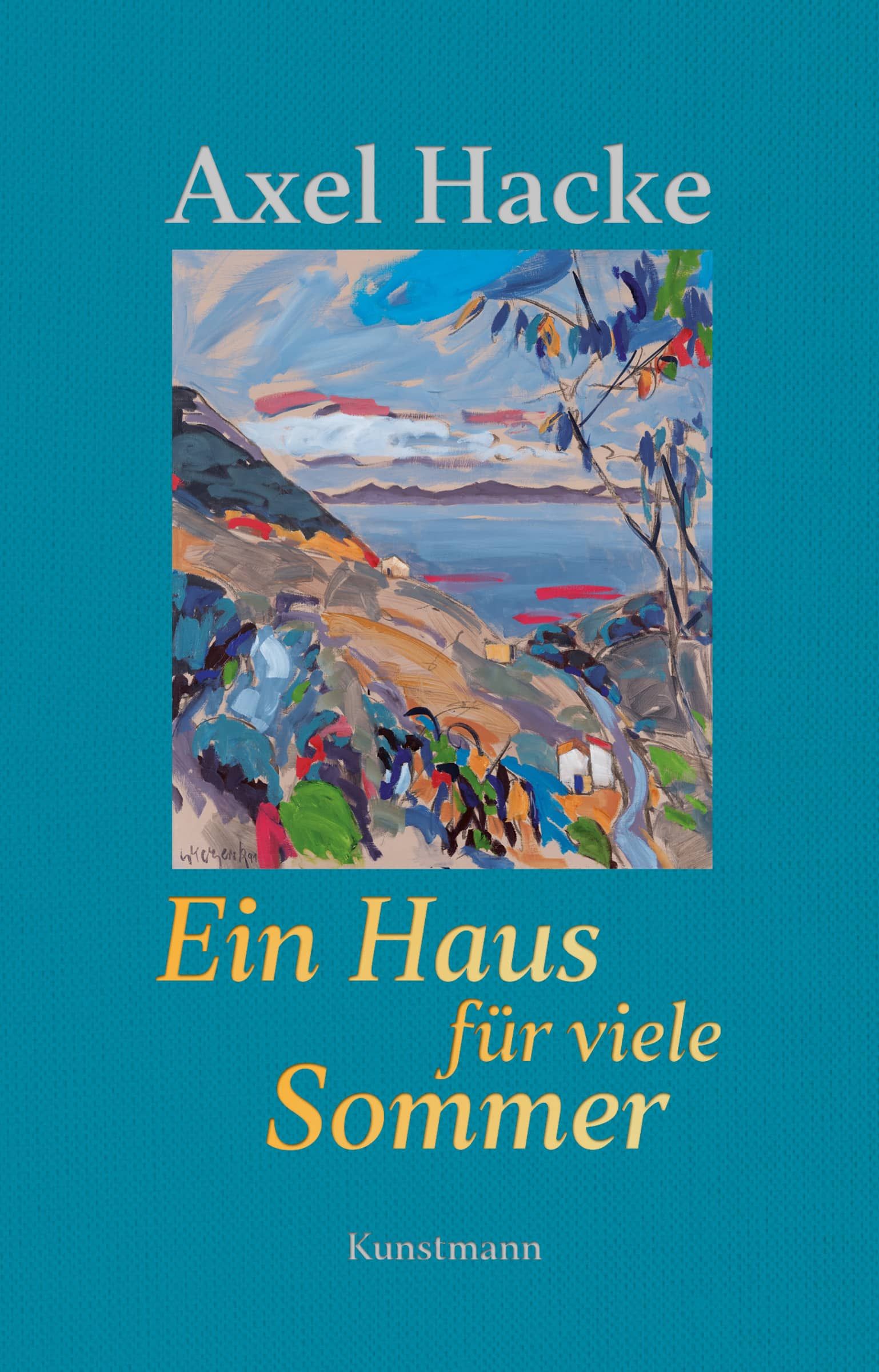
Illustrations: All pictures are by Thomas Weczerek and have been reproduced with kind permission from the book “Thomas Weczerek. Bilder und Plastiken”.
Axel Hacke: “Das Beste aus aller Welt” [“The best from all over the world”]
Controversy – I (don’t) want a holiday home!
Interview: Ulrich Stefan Knoll, March 2022
One Comment
Durch Zufall las ich im “Lesetipp” in der Badischen Zeitung, Ausgabe Kreis Emmendingen vom Samstag. 22. Juli d.J. von der Herausgabe Ihres Buches “Ein Haus für viele Sommer”. Seit 1986 verbringe ich meinen Sommerurlaub in CAPOLIVERI ! Dieses Jahr war ich schon im ‑leider total verregneten Mai, mit meinem Enkelsohn und seiner Freundin dort; er wollte unbedingt sehen u. erleben, wo ich bis 2022 stets 3 Wochen, jeweils im August, glücklich war. Beim Lesen des Artikels nun drängt es mich nahezu, Ihnen meine Freude über das gleiche Empfinden, die gleiche Erfahrung mitzuteilen. Unser Urlaubsquartier war (ist) stets auf dem Weg zum Meer im Pinienhang von Badisugarello. Ich wünsche Ihnen weiterhin eine glückliche, erlebnis- wie ideenreiche Zeit auf Elba! Man muss einfach dort gewesen sein! Arrivederci!