
Where continents meet: The exclave of Melilla
Enrique Nieto and Art Nouveau in Melilla. A modern European-North African city at the intersection of four cultures, two continents, and a multitude of perspectives.
Melilla reveals itself as a geopolitical curiosity already upon one’s approach: a Spanish enclave in African territory, surrounded by the sea and the Moroccan hinterland. The view from the aeroplane window reveals border fences, the turquoise of the Mediterranean, and a grid of clearly delineated streets. Even before touch-down, it is apparent that this is not simply a border between two states, but an intersection between cultures, continents, and perspectives.
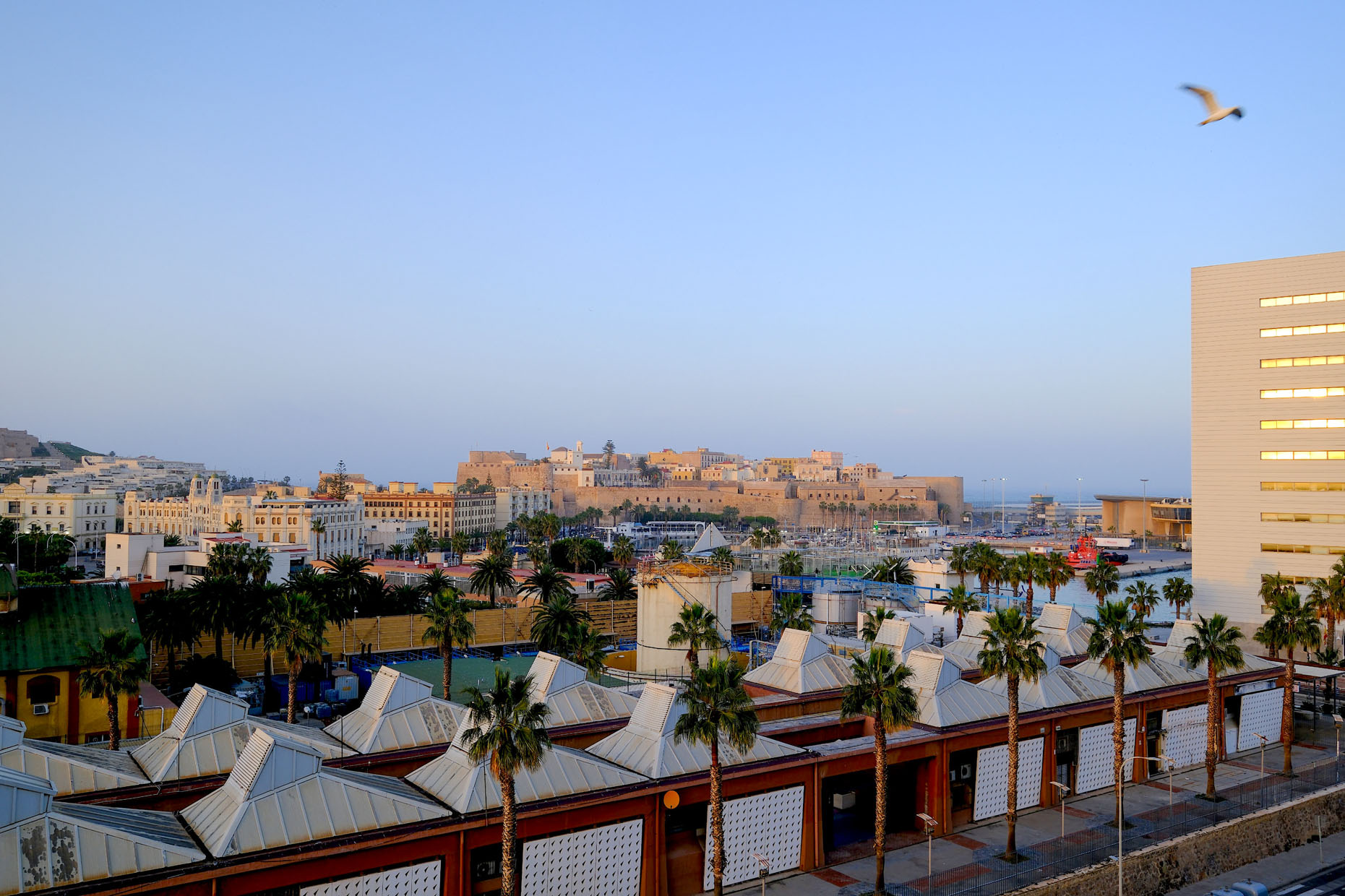
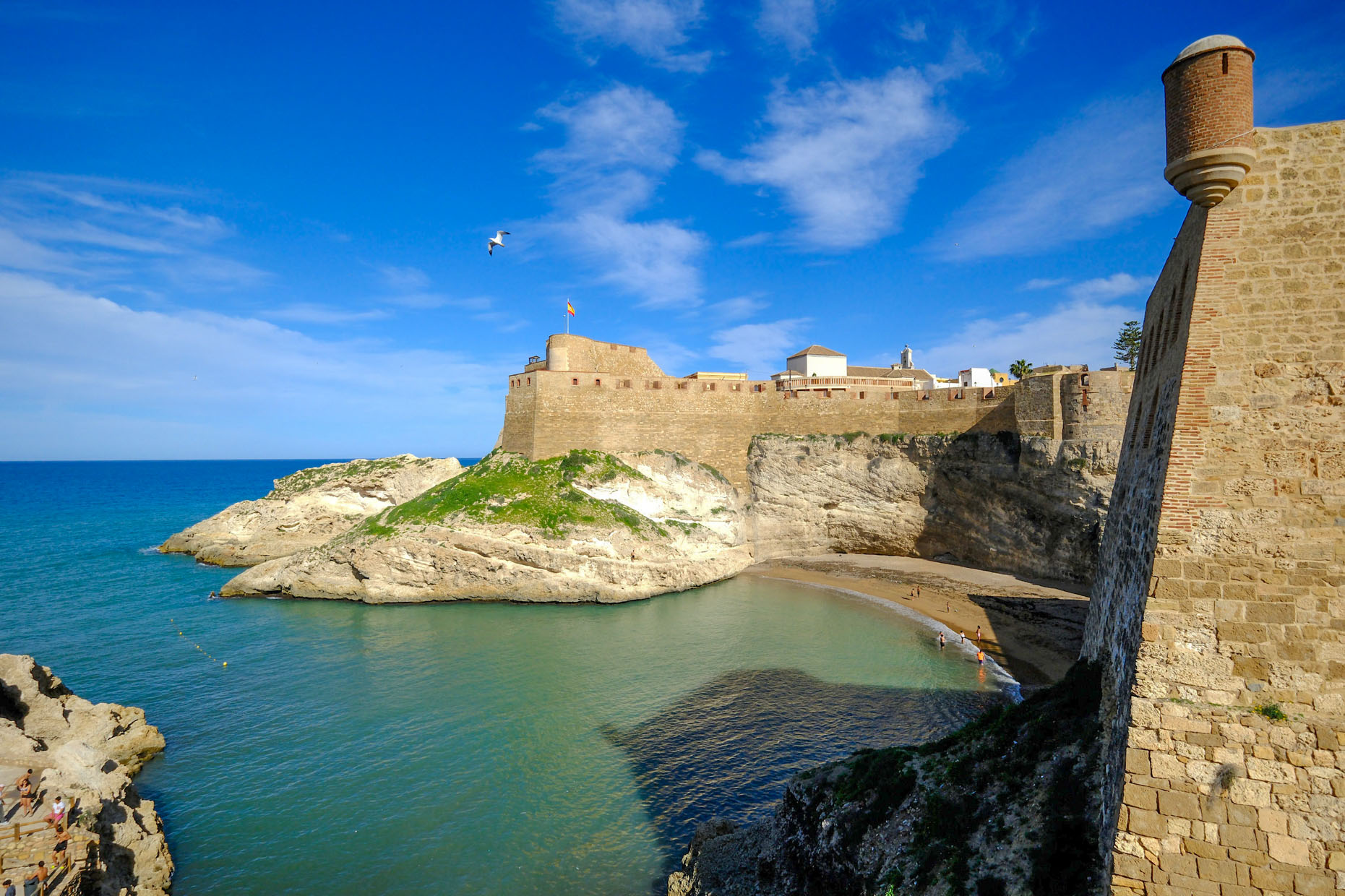
Dubbed “The City of Four Cultures” by locals, Melilla boasts a long and rich history. The town formerly known as Rusadir was founded already in 1100 BCE as part of a Phoenician colony, later passing into Punic, and then Roman control. Various Muslim Caliphates presided over the area during the Middle Ages after the Arab invasion of the Maghreb. Conquered by Spain in 1497, Melilla has remained under Spain’s governance, even after Morocco’s independence in 1956. This continuous Spanish rule shapes Melilla’s unique legal and cultural status to this day. Thanks to its dynamic past as place of immigrants and conquerors, four cultures live side by side in Melilla—Spanish-Christan, Muslim-Berber, Jewish and Hindu—often visible at the same intersection, in daily life, during festivities, and in its architecture.
These days, the Spanish territory is primarily familiar from news footage completely unrelated to architectural topics. The focus here is on refugees, heavily guarded borders, patrolling forces. Hidden behind these political headlines, however, lies a remarkable city: architecturally, atmospherically, and culturally. To enter Ensanche, or “New Melilla,” is to walk into one of the largest open-air museums of European Art Nouveau, with its curves, iron, and ceramic. And amid it all, Enrique Nieto y Nieto, the Catalan architect that made Melilla his life’s work.

Nieto was hardly an unknown when he arrived in Melilla in 1909. He had worked in Barcelona with two masters of Catalan Modernisme, Lluis Domènech i Montaner und Antonio Gaudí. In Melilla Nieto found an emergent but still architecturally undecided space. The city had begun to expand beyond its original fortifications after the turn of the century. While military engineers laid out the axes, squares, and grids, it was Nielo who gave the new district its soul. Within three decades Melilla boasted one of the largest coherent ensembles of Catalan Art Nouveau in the world – approximately 900 buildings, of which more than 500 were in Modernisme, Art Deco or Neo-Mudéjar styles. Catalan Modernisme, a regional variant of Art Nouveau, combines traditional craftsmanship with symbolic ornamentation inspired by nature, featuring botanical forms and asymmetrical design. Its characteristic features are undulating facades, curved balconies, decorative wrought iron work, and the interplay of diverse materials such as ceramics, glass, and stone. The style conceives of architecture not as a mere building, but as a societal self-portrait – full of symbols, colours, and organic shapes. This attitude is epitomized in Antonio Gaudí’s sense that since there are no straight lines or sharp corners in nature, the art of building must be based on the curve.
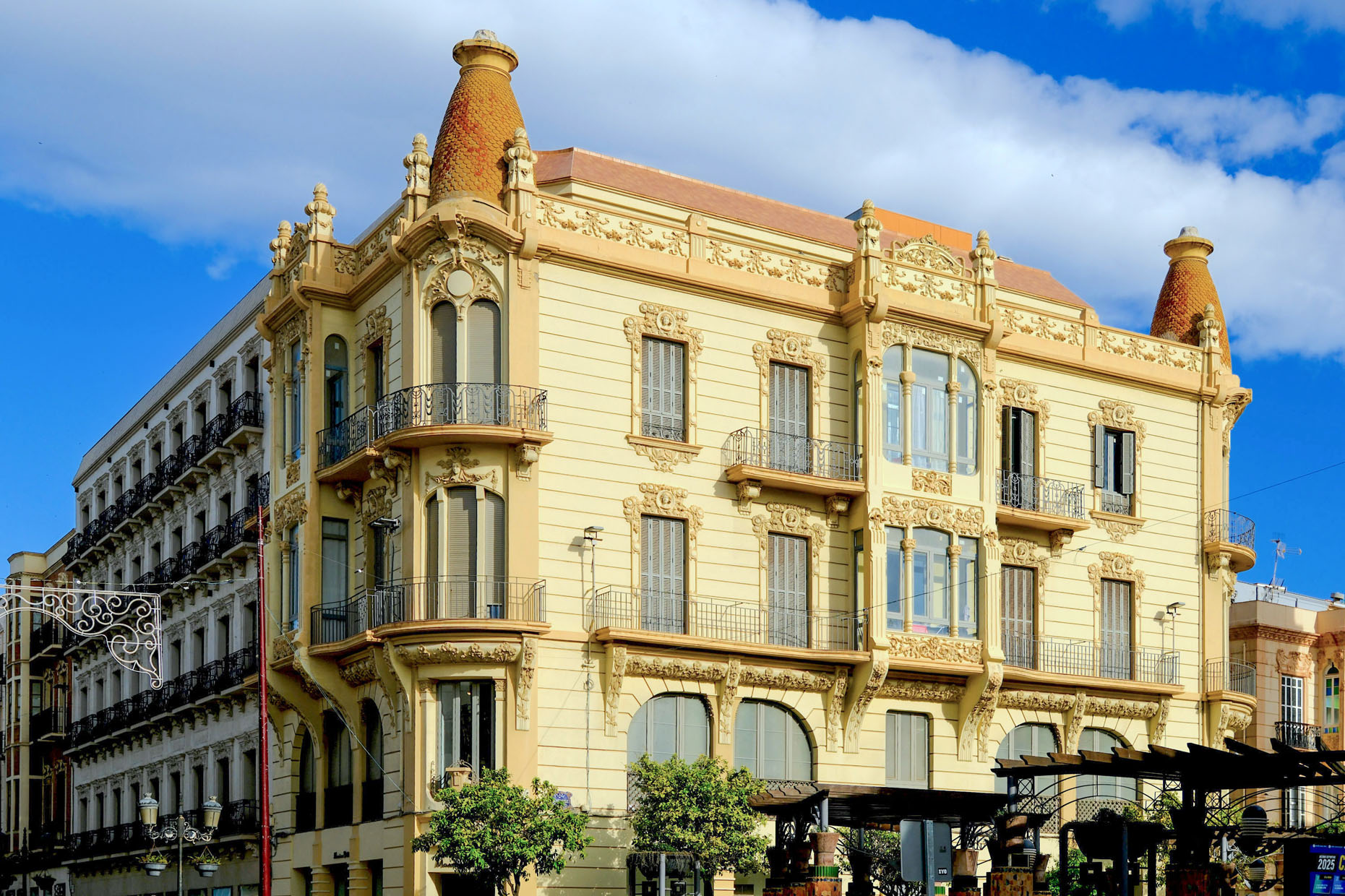
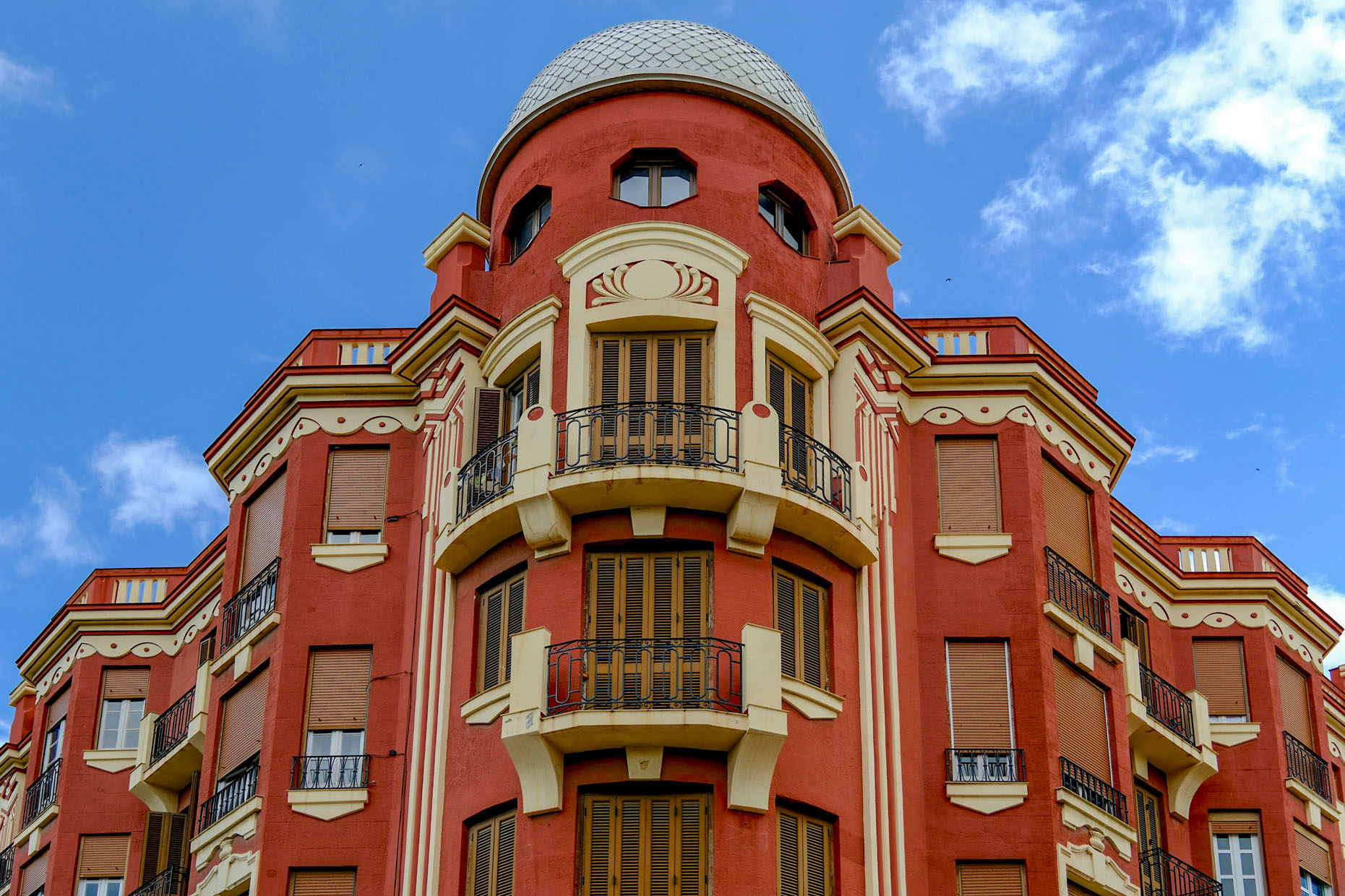
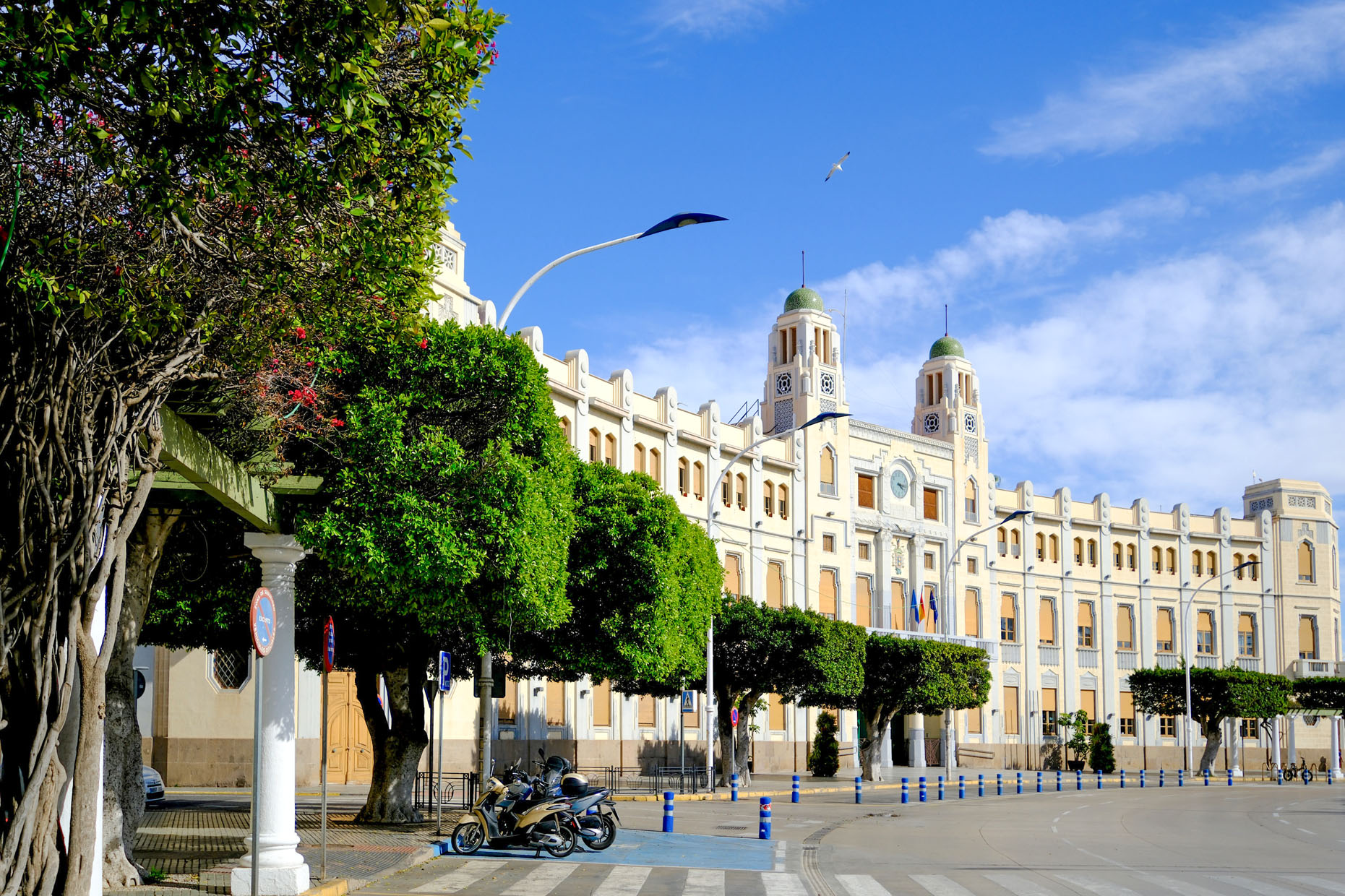
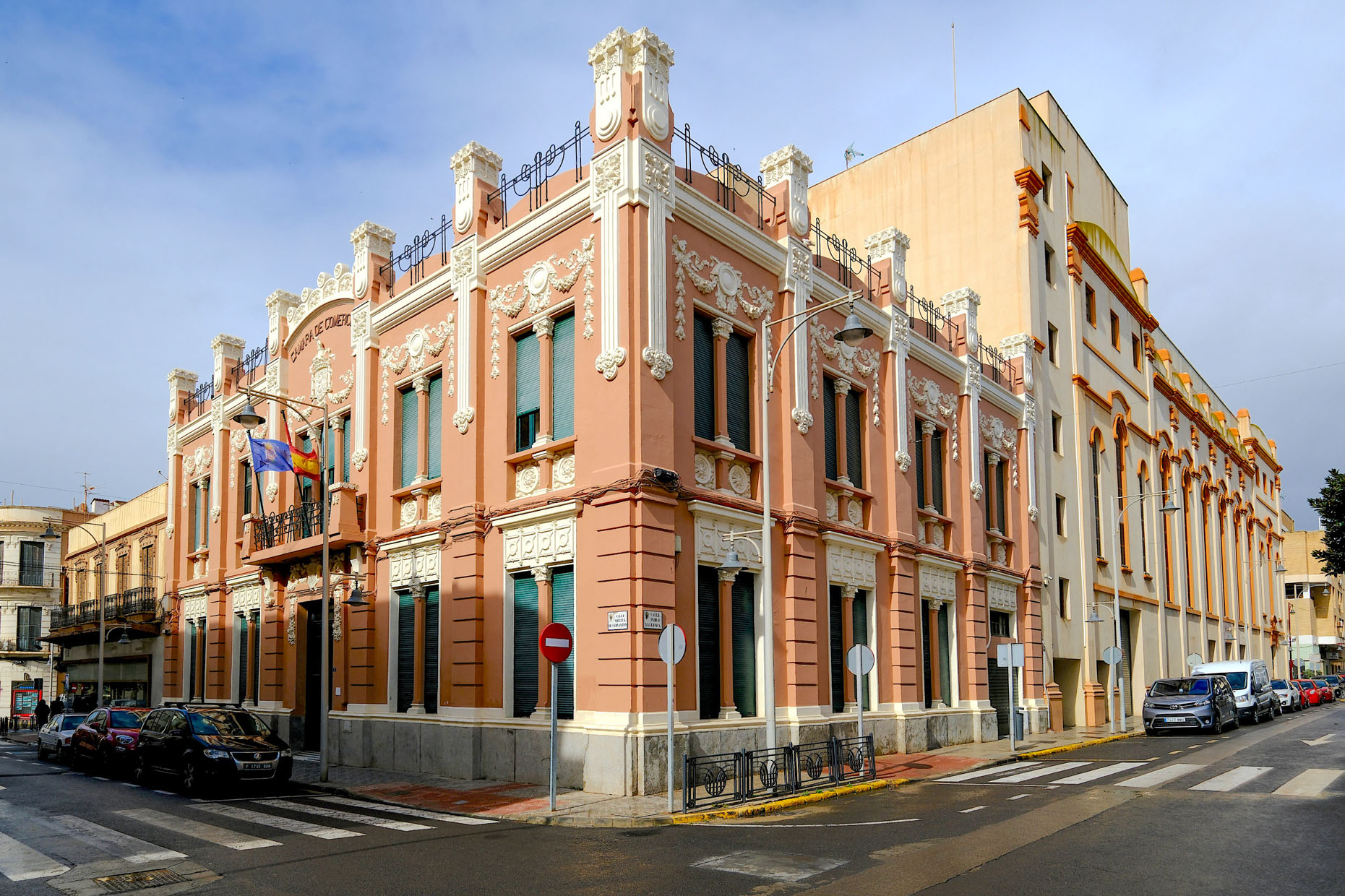
Nieto’s masterpieces include, among others, Edificio El telegrama del Rif (completed 1912, picture 4), Cámara de Comercio (1913, picture 5), Edificio La Reconquista (1915, picture 6) and later Edificio Rojo (1935, picture 7) and the Palacio de la Asamblea (around 1948, picture 3). While his first buildings exhibited a rich variety of forms, Nieto’s style shifted to Art Deco from the 1920s onwards, embracing geometric rigor, vertical accents, rhythmic repetitions. The Palacio de la Asamblea – both city hall and urban planning backdrop – illustrates this with its concave facade and twinned towers.
Art Deco is a style of the 1920s and 30s characterized by clear geometric shapes, strong vertical lines, symmetrical facades, and decorative abstraction. In contrast to Modernisme’s floral exuberance, it emphasizes elegance through reduction and repetition. Nieto’s work evinces Art Deco with its stretched pilasters, angular balconies, and in the ornamental motif stripped back to its essence.

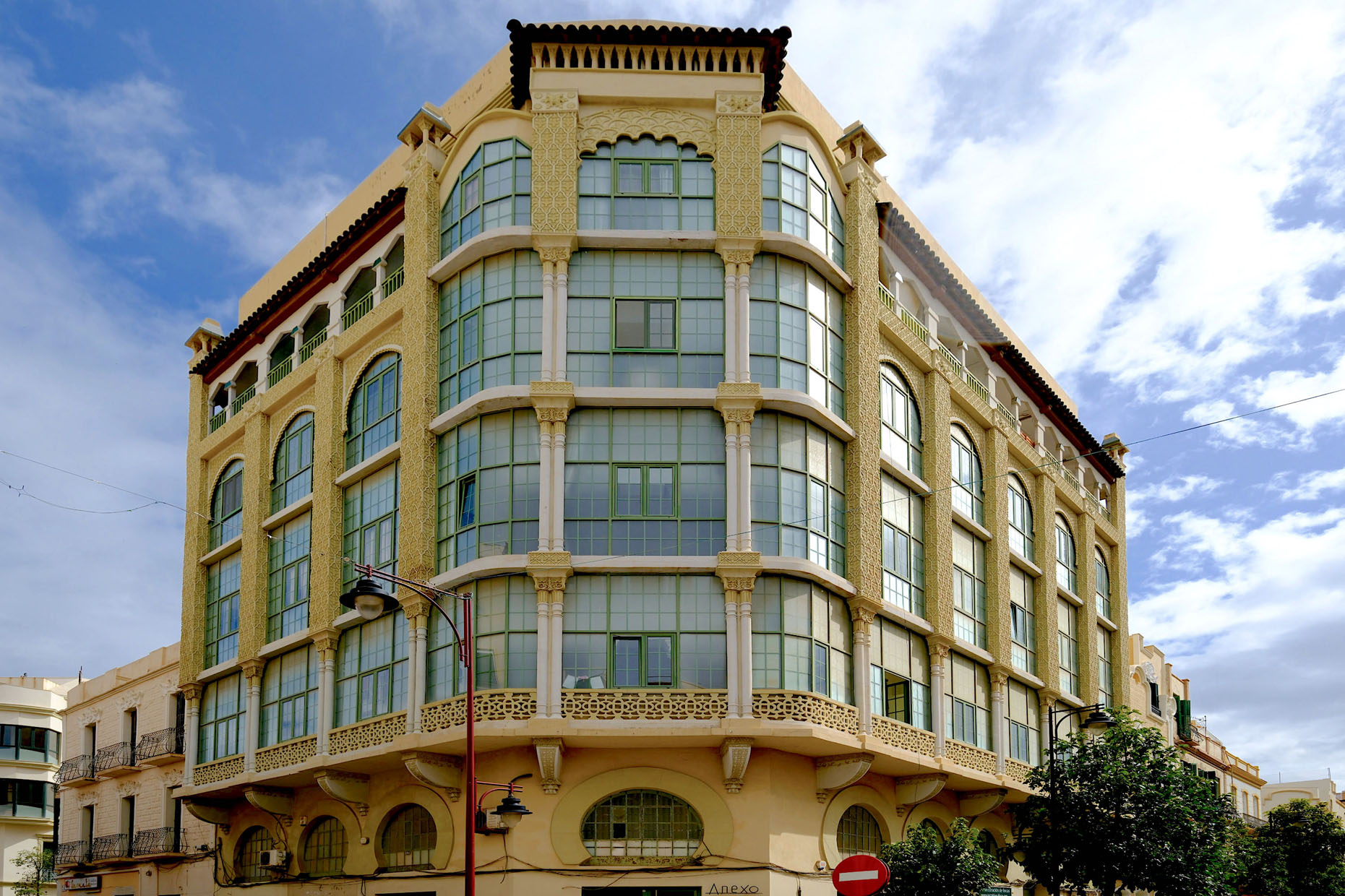
But Melilla was not merely a copy of Barcelona. Neo-Mudéjar buildings like the Mezquita Central (Enrique Nieto, 1945, picture 10) or the Casa de los Cristales (Ramón Ginorella y Otros, 1926, picture 9) mingle Moorish arches, zigzag tiles, and horseshoe arcades with Art Nouveau details. The city becomes an architectural interpreter between Europe and the Maghreb – evidence of the openness described by Fritz Weidner at the beginning of the 20th century: “A style is not used, … it emerges and develops logically from specific temporal and spatial conditions, from the way people live, the technical possibilities and materials.”
This cultural openness stands in stark contrast to the current political situation. Morocco does not recognize Spain’s claim to Melilla and to this day maintains its right to the city. Nevertheless, close economic and everyday connections persist – through business relationships, family networks, commuters. The border simultaneously divides and connects.
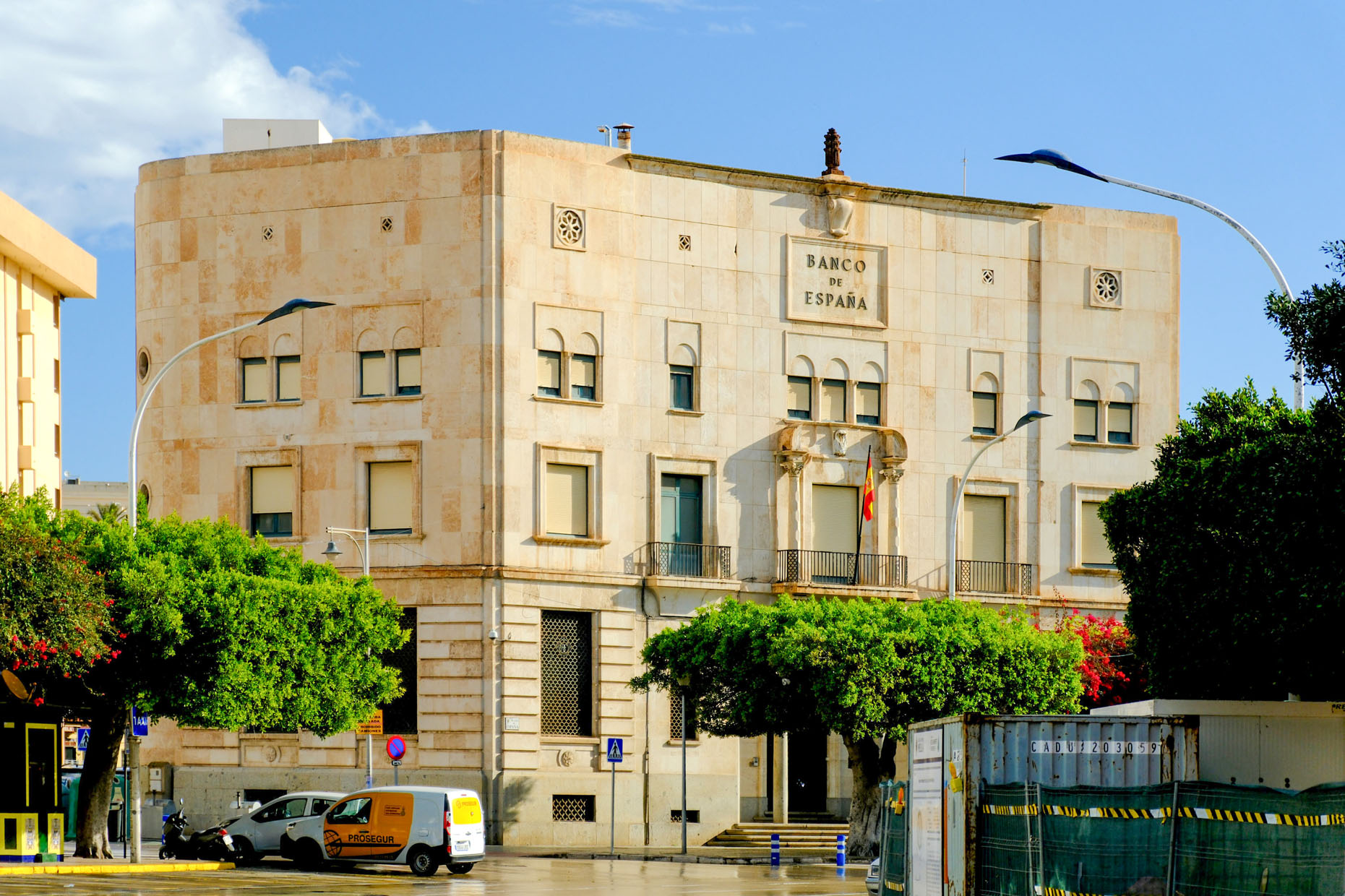
Walking across the main square, Plaza de España, one sees facades gesturing to the Neobaroque, to Modernisme, and the Vienna Secession – densely laid out, carefully crafted, and of varying moods. Further north, the Triángulo de Oro is a showcase for Art Nouveau. The Parque Hernández takes a different approach: rationalist late works – here by Juan de Zavala (Edificio Antiguo Banco de Espańa, 1943, picture 8) – direct one’s attention to the last figurative offshoots of the twentieth century. Only a few footsteps separate effusive ornamentation from sober lines – the city walk as time-lapse.
With fewer than 100 000 inhabitants, Melilla combines Andalusian lightness with North African density. Street cafés recall southern Spain, while its smells evoke Nador’s medina. Berber wall tiles, Moorish arches, and symmetrically laid out squares framed by palm trees combine with Art Nouveau facades that could just as easily be in Catalonia. Melilla preserves its treasures without tourism’s din. Short distances, open cafés, conversations in Spanish, Arabic, and the Berber language, Tarifit – here everyday life plays out amidst architectonic artistry. Melilla is a living archive for anyone interested in exploring the transition from historicism to modernism; a place rich in stories, pushing the limits of stone, iron, and ceramic. Curves tell of optimism, tiles reflect trade, hope, and history. Melilla proves that architecture shapes not only space, but identity – precisely at the point where continents touch.
Author: Jan Dimog
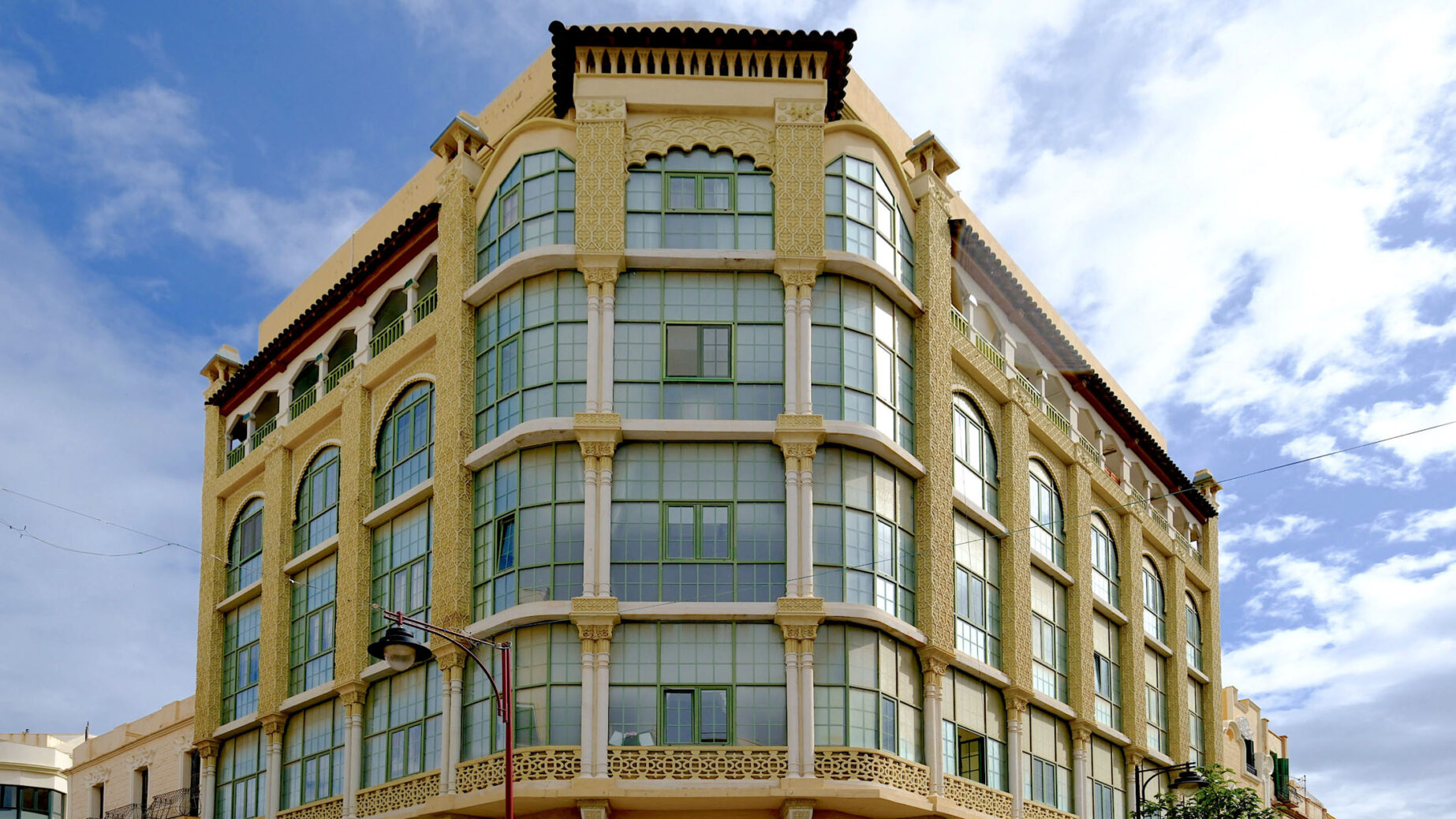
Photos: Melilla Modernisme, Casa de Los Cristales (Cover photo), Melilla la Vieja, Altstadt (1, 2), Edificio El telegramma del Rif (4), Cámara de Comercio (5), Edificio La Reconquista (6), Edificio Rojo Enrique (7), Palacio de la Asamblea (3), Mezquita Central (10), Modernisme, Casa de Los Cristales (9), Edificio Antiguo Banco de Espana (8)
Photo credit (all): © Jan Dimog / thelink.berlin

0 Comments