The Westerwald Wonder
Travelling by campervan taught Caro and Nils Fröhlich how little it takes to be free and happy. Once back on home soil, they translated their experiences into architecture. The result is the Kleine Bleibe [Small Dwellings] – holiday homes without ballast that provide a breath of fresh air in the Westerwald.
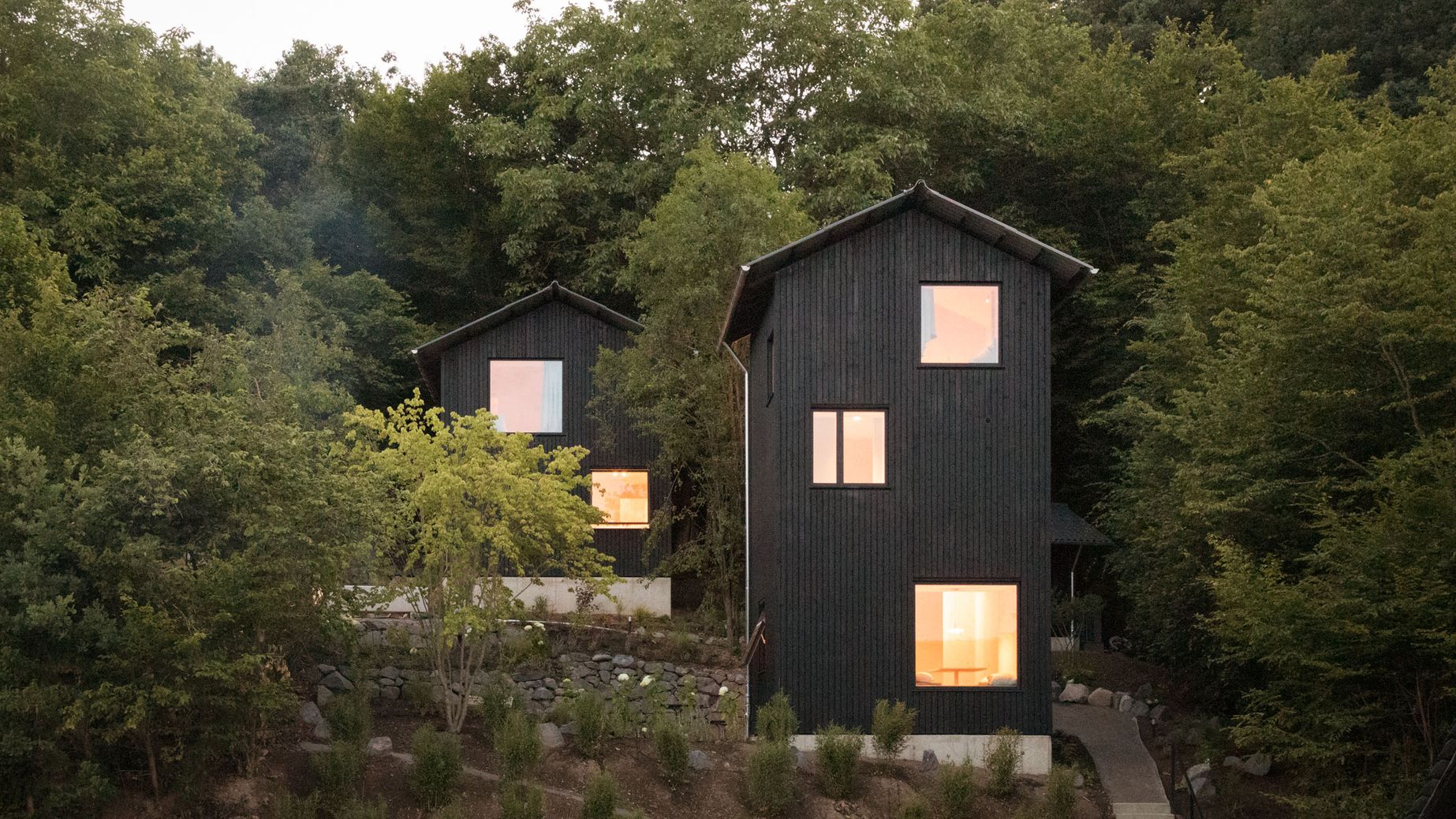
Sometimes it takes an impulse, a drop of water, that doesn’t make the barrel overflow in a positive sense but sets things in motion. In this case, it is two black wooden houses that stand hidden on a hillside, refer to regional traditions and yet at first glance seem strange. Their construction has caused a stir. Today the Kleine Bleibe is a showcase project in the southern Westerwald.
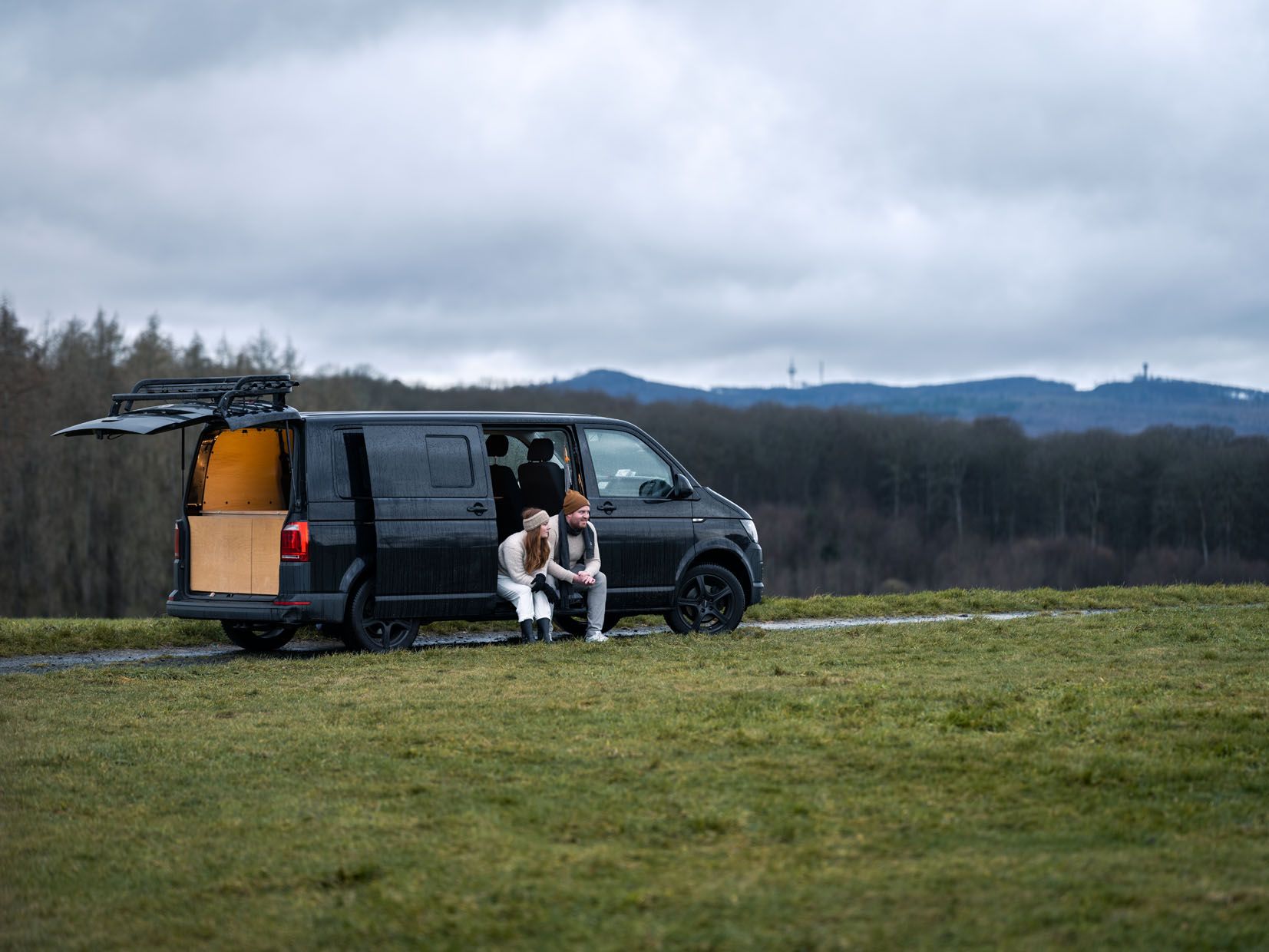
To start such a project, you need courage, a clear goal and a touch of coincidence. Initially, Caro and Nils Fröhlich, both native Westerwalders, did not have their own area in mind. Life had taken them south and shown them many interesting places in Europe. When the wish to have their own holiday home arose, they kept asking themselves one question: “How would we do it?” Thoughts turned into a pro-con list. From then on, they looked for a property with atmosphere, a place in the middle of nature, far away from the hustle and bustle of everyday life. It surprised them that their innermost desires should lead them so close to their roots again.
Home.
Twenty kilometres away from their hometown they found what they were looking for. The small village of Reckenthal with its approximately 100 inhabitants is a suburb of the shoemaking town of Montabaur and lies in the Nassau Nature Park. The half-timbered houses from the 17th and 18th centuries dot the hilly landscape and are mostly heritage listed. People greet each other with “Hui Wälla?” and those who answer with “Allemol!” reveal themselves to be true Westerwalders.
The Gelbach meanders its way past Reckenthal. Over millions of years, the water has cut through the Rhenish slate and created the rock formations and lower valleys typical of the region. A paradise for hikers and nature lovers. A popular destination is the sculpture trail that leads directly past the Kleine Bleibe. Since 2009, 42 wooden sculptures have lined the almost ten-kilometre-long circular trail. It leads out over the extensive hilly landscape with flowering meadows and fruit trees and down to the Gelbach stream, which splashes along towards the Lahn. From the hilltops, you can see the shining yellow baroque castle of Montabaur. And if you climb up early in the morning and catch the first rays of sunshine between the fields of mist, you almost feel like you’re in Tuscany.
In terms of tourism, however, the region is nowhere near as good as its famous sister. The small hotels and inns with quaint names and squiggly display cases at the entrance tell of a bygone era. The Westerwald with its endless forests, meadows and rivers disappeared from the focus of travellers for many years. Too conservative, too backward, too old-fashioned. The cold wind that whistles across the heights in the well-known folk song “Oh du schöner Westerwald” didn’t exactly help with location marketing either. But things have been changing for a few years now. Thanks in part to Covid, people have rediscovered the beauty of their immediate surroundings. Short journey, maximum recreation. Now it’s micro adventures and detox breaks that attract people; sleepy is suddenly considered authentic. New drawcards are needed for these new guests. And the Kleine Bleibe is right in tune with the spirit of the times.
Stay a while.
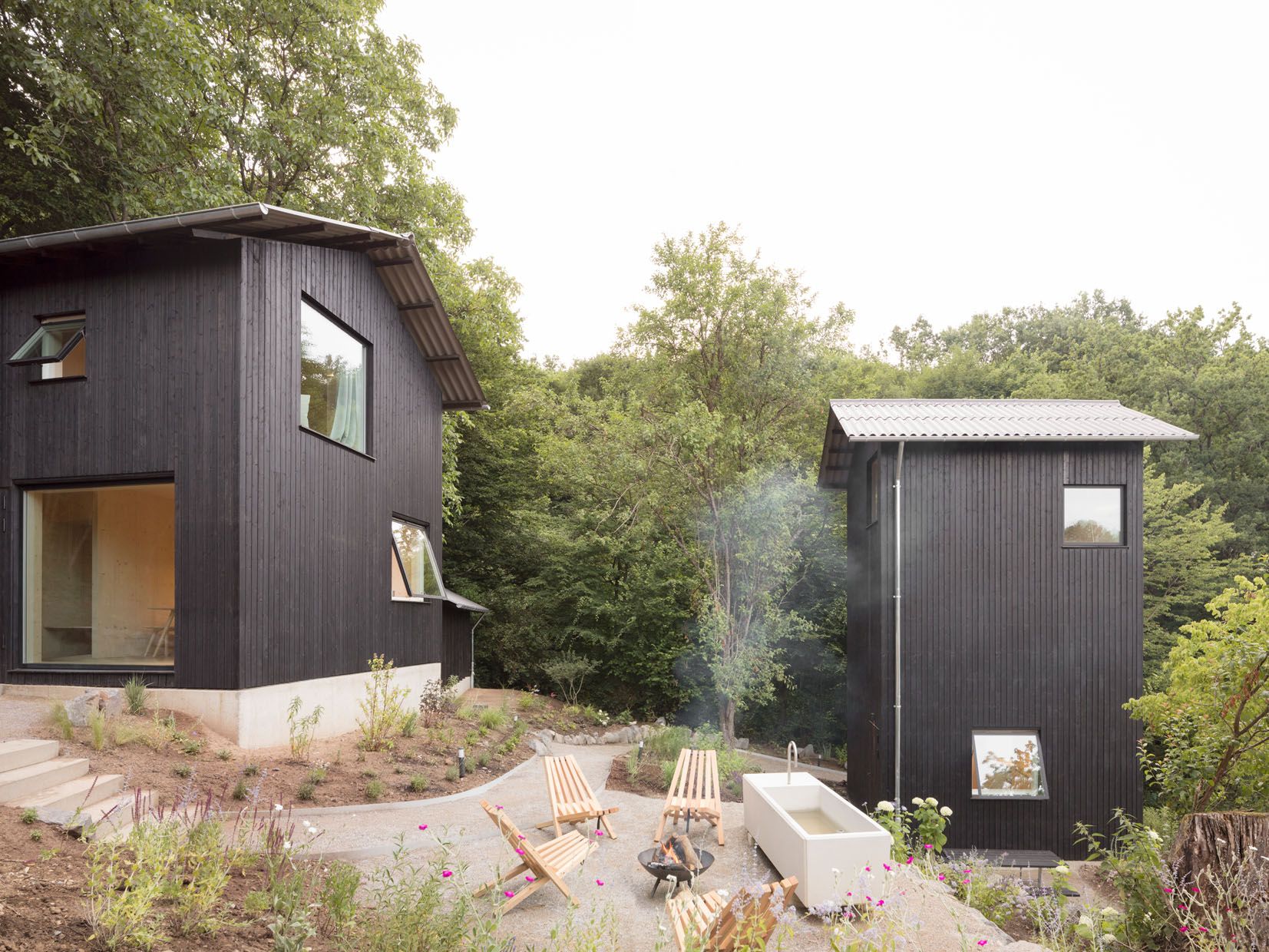
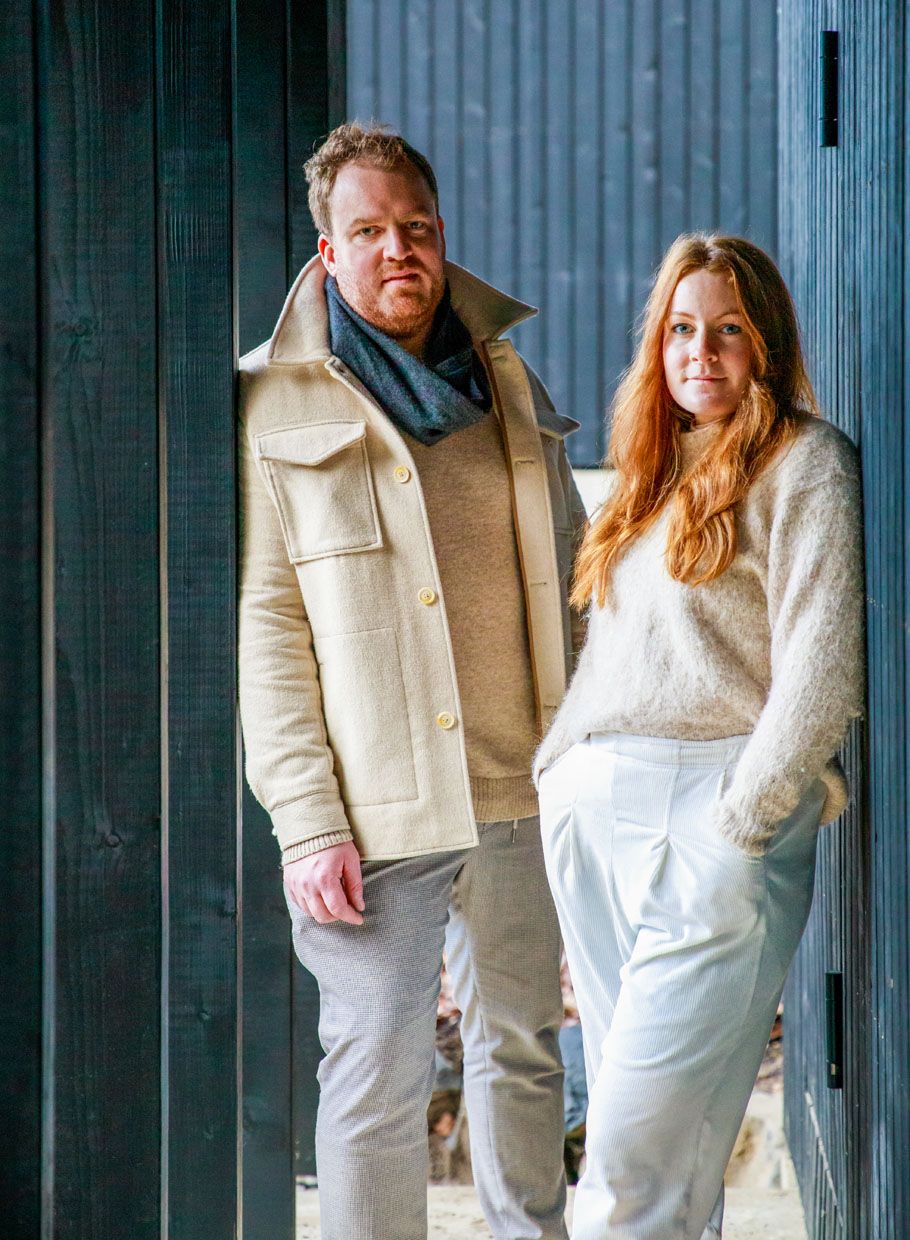
With their two wooden houses, Caro and Nils Fröhlich have made a statement. The carpenter and architect and the hotel and marketing expert formulated their own wishes and needs and derived the concept from them. What was planned as two holiday homes for guests interested in architecture sparked a small boom in the region. At first, this overwhelmed the local people, but those responsible for tourism immediately recognised the potential.
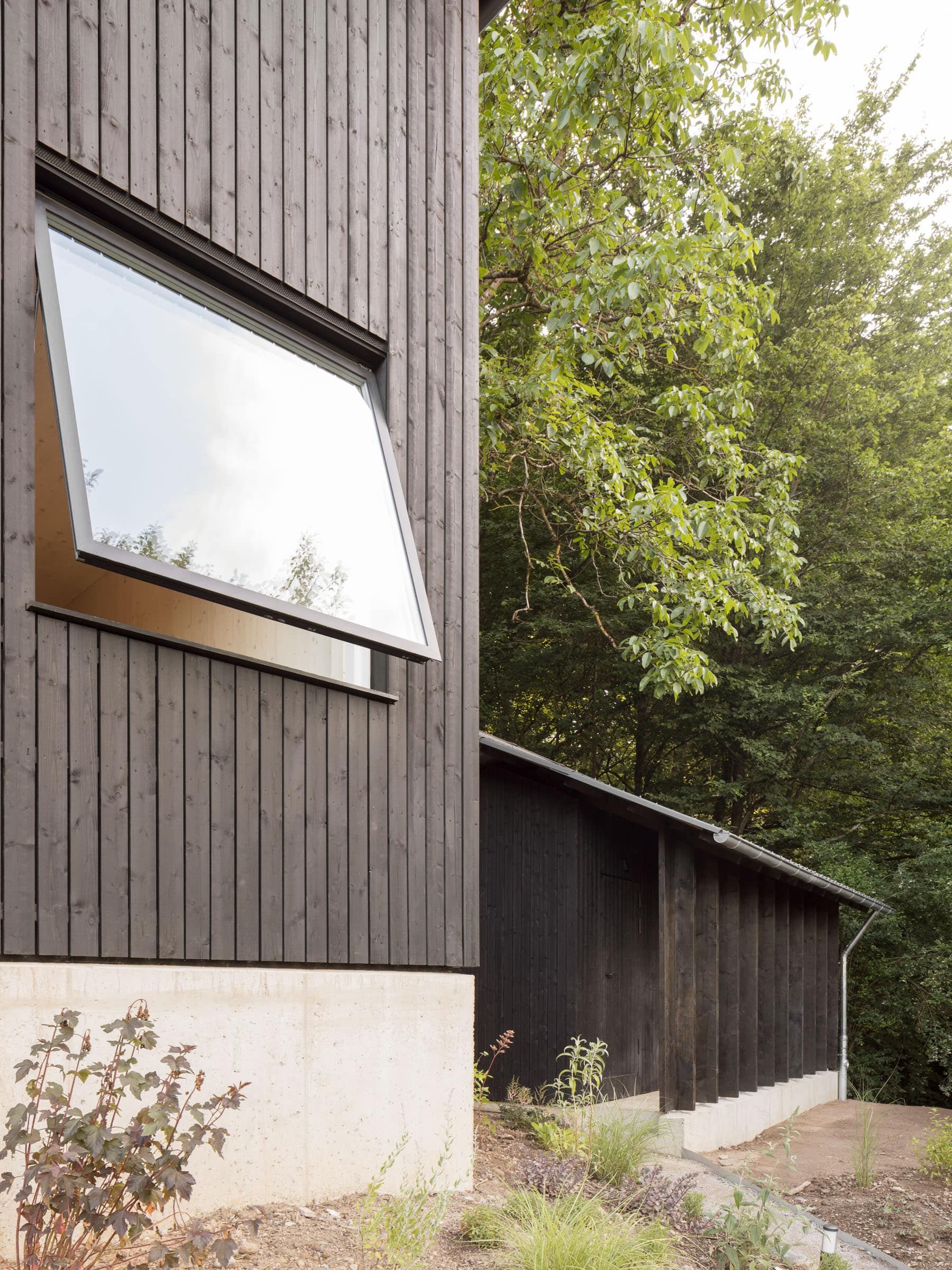
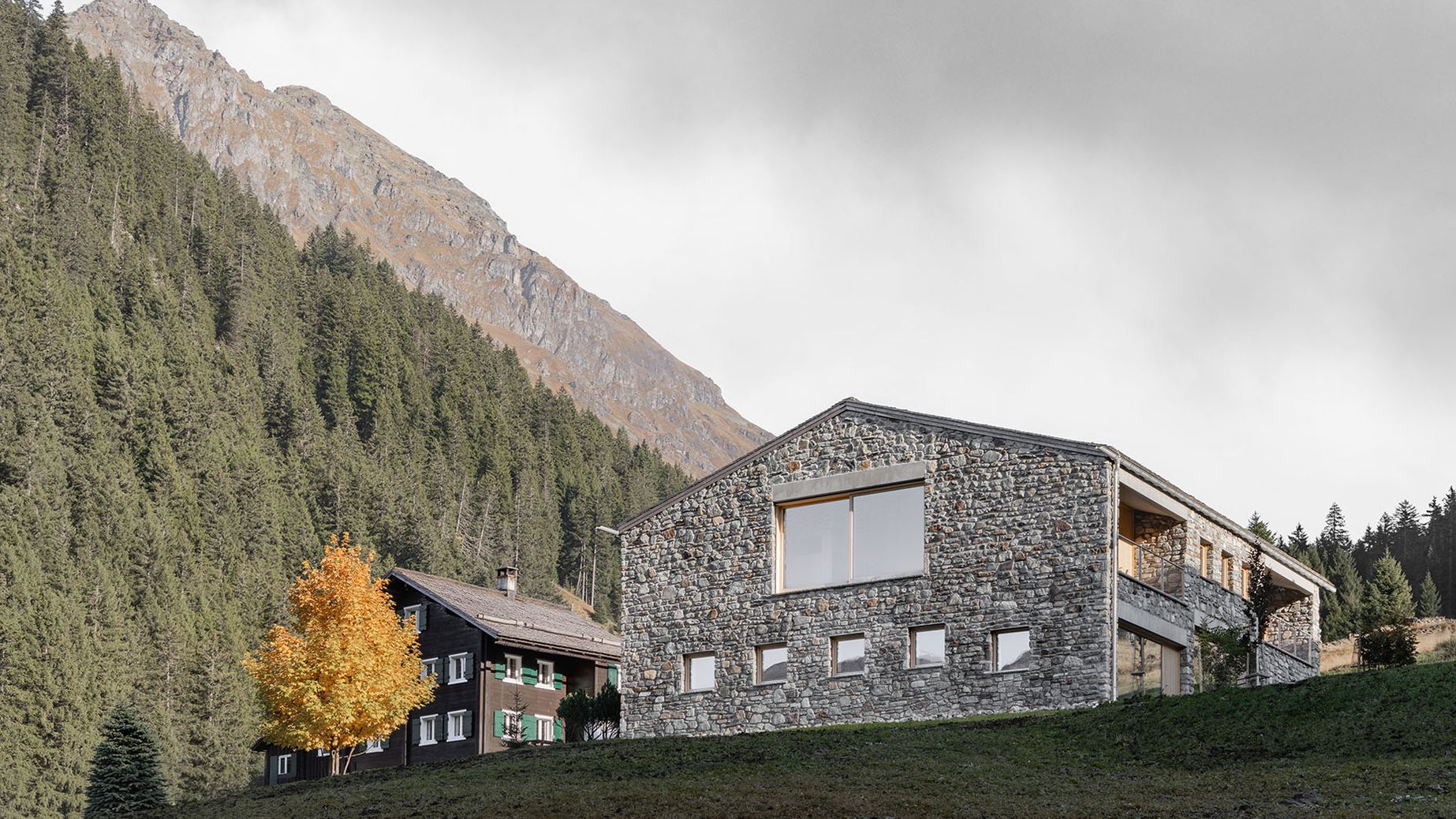
Modern architecture polarises, Nils Fröhlich knows this. Yet the wooden houses tie in with the region’s building tradition. After all, wooden houses have always been built in the Westerwald, standing on a stone base and with a projecting roof. Just like the Kleine Bleibe. The only difference is that now the base is made of concrete and not natural stone, and the house is built solidly of wood, just as it was before the time of half-timbered houses, when there was still enough wood available and solid construction was the standard. For Nils Fröhlich, the Kleine Bleibe is therefore the consistent further development of historical building culture.
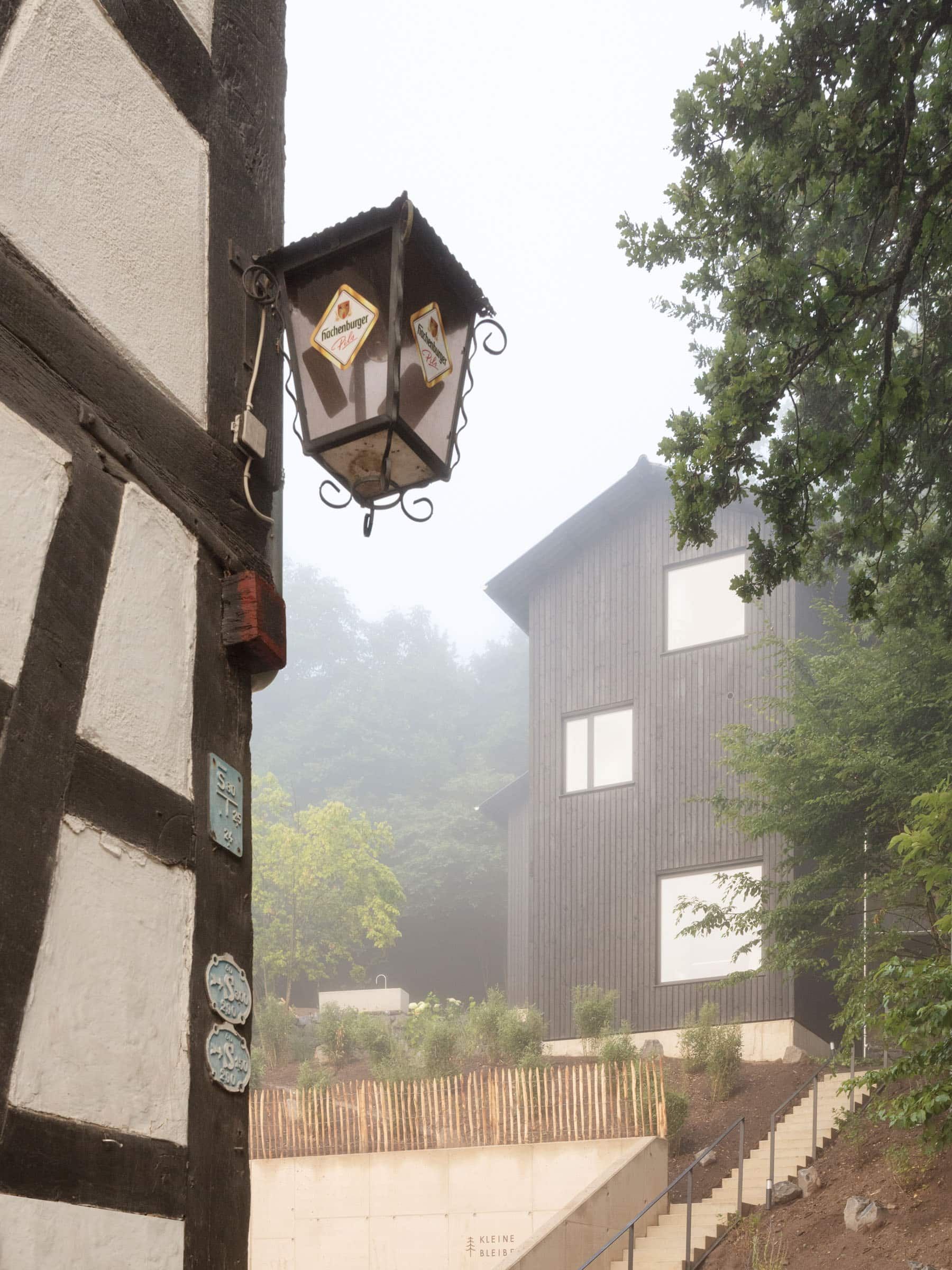
The Westerwald Basaltköppe [“Basalt heads” i.e., stubborn] – as the locals affectionately call themselves – initially saw things differently. They lived up to their name and put obstacles in the way of the young builders. The reduced wooden houses seemed too foreign in contrast to the historical centre of the village. There was unrest during the construction period, and many talked about it. Only the innkeeper of the Brunnenstube [Fountain Inn] opposite the houses was enthusiastic from the start. From the vantage point of his terrace locals and hikers met to discuss and comment on the architecture of the houses.
Forest bathing.
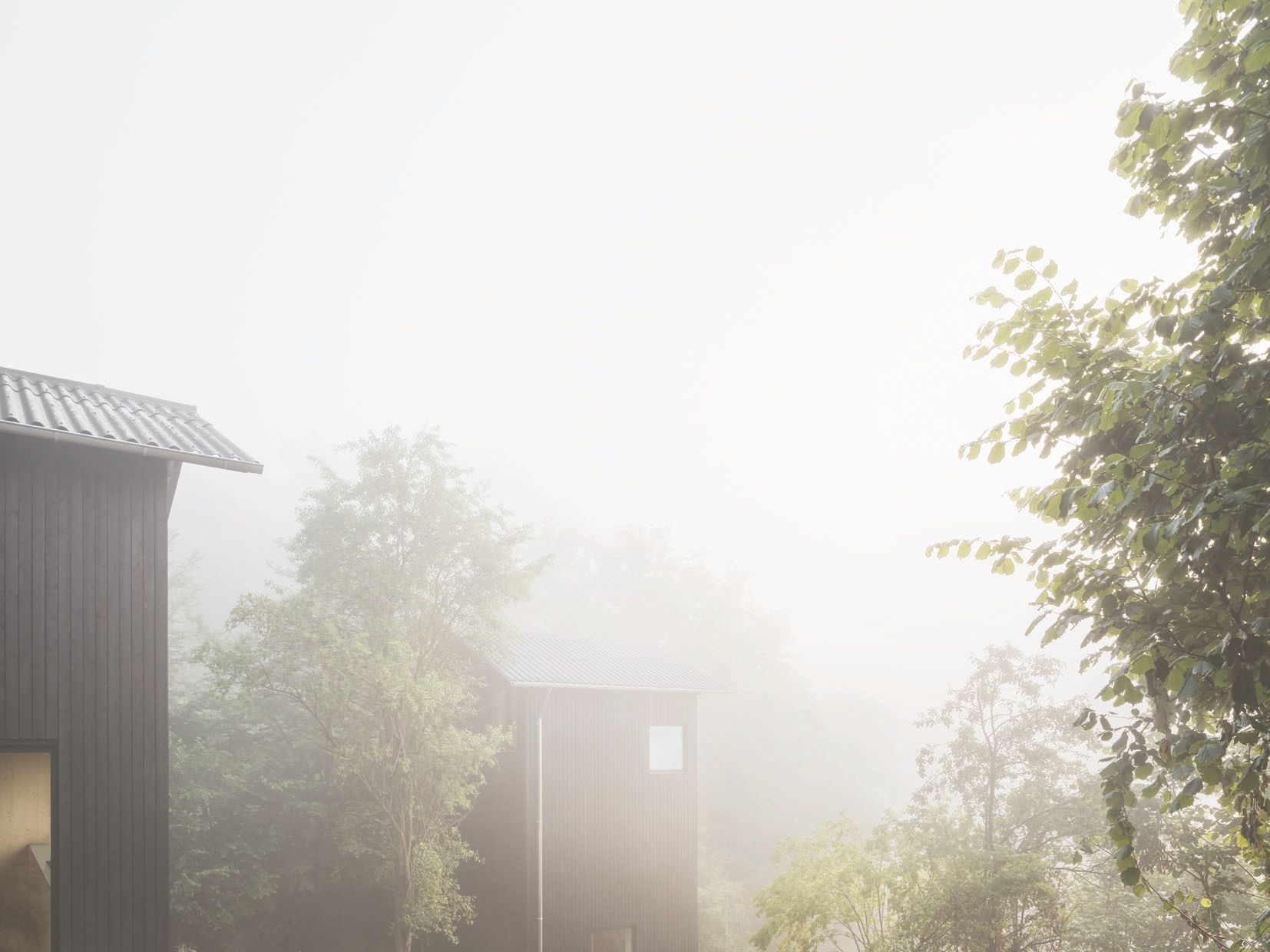
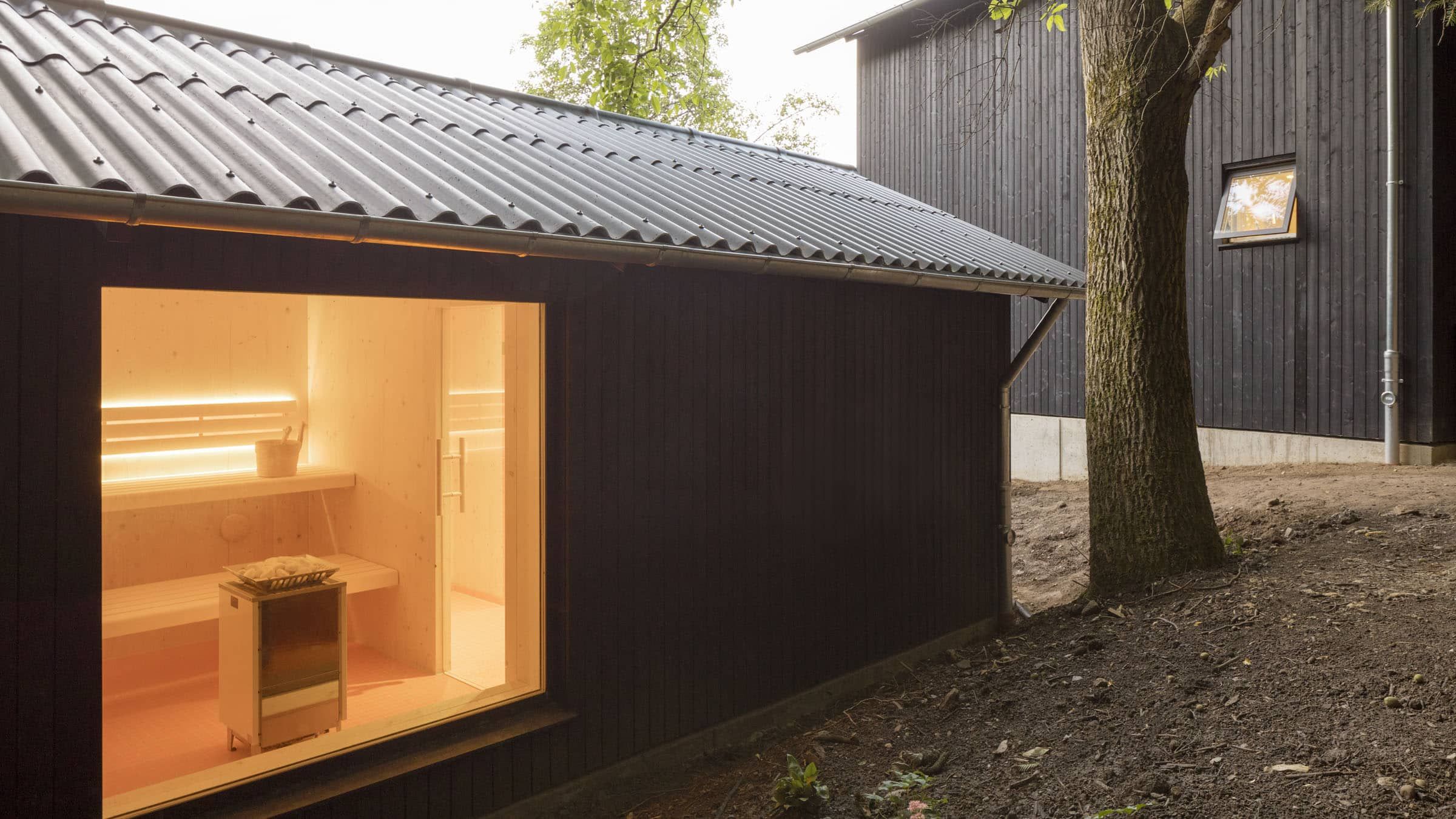
At first glance, the houses stand out, although in a subtle way. It looks almost as if they are hiding in the forest and at the same time looking curiously into the landscape. Black-glazed wood, a gable roof, so far nothing unusual. But when you look at the façade, you notice: Nothing here is ordinary. Large, square window openings, cut out of the façade as if by chance, look like shop windows. If you approach the houses from the street, you are reminded of the illusory giant in Michael Ende’s children’s novel Jim Knopf and Luke the Engine Driver. From a distance, the houses tower loftily overhead. If you climb the steep stairs and get closer to them, they literally shrink until they finally become almost invisible between the trees and embrace their guests.
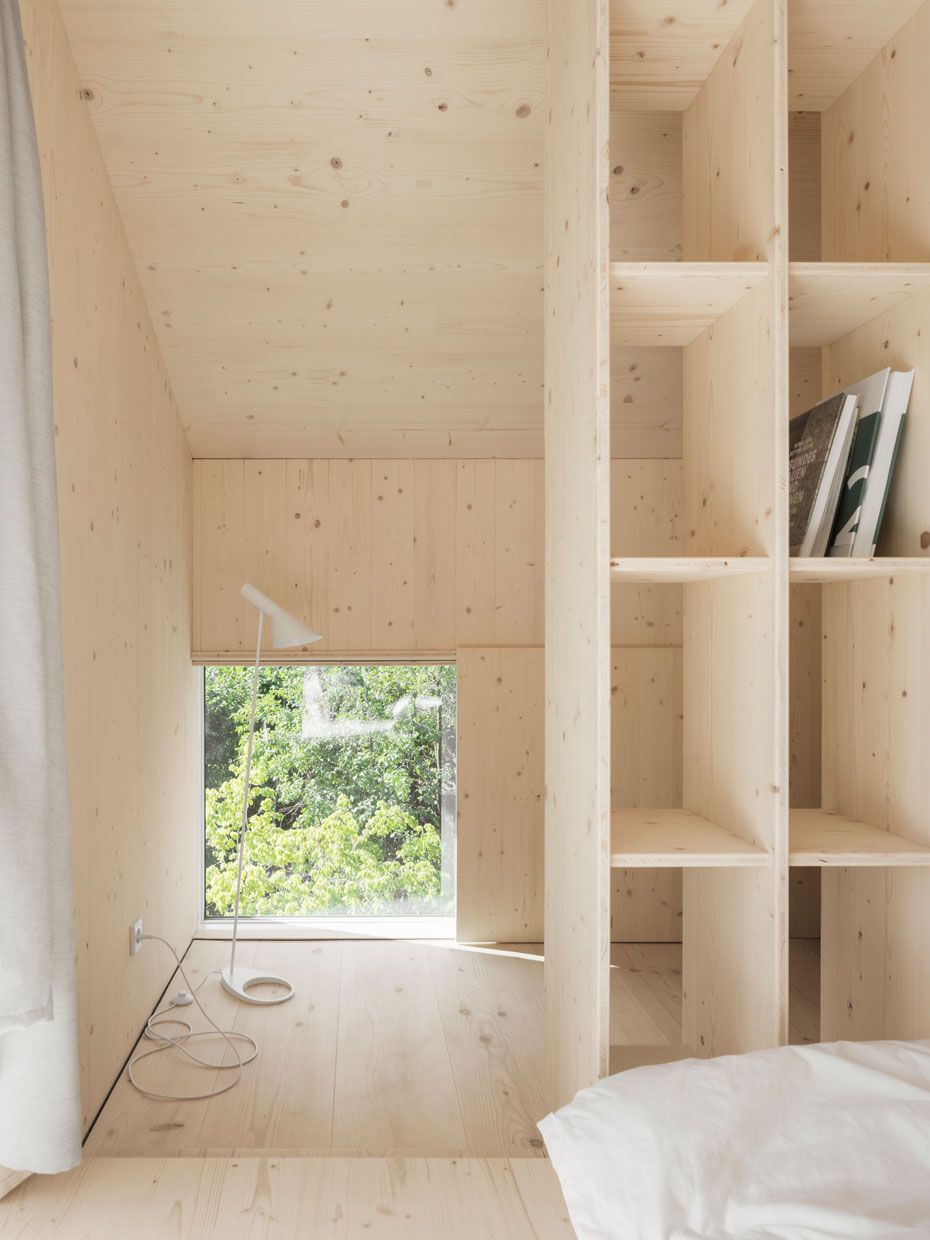
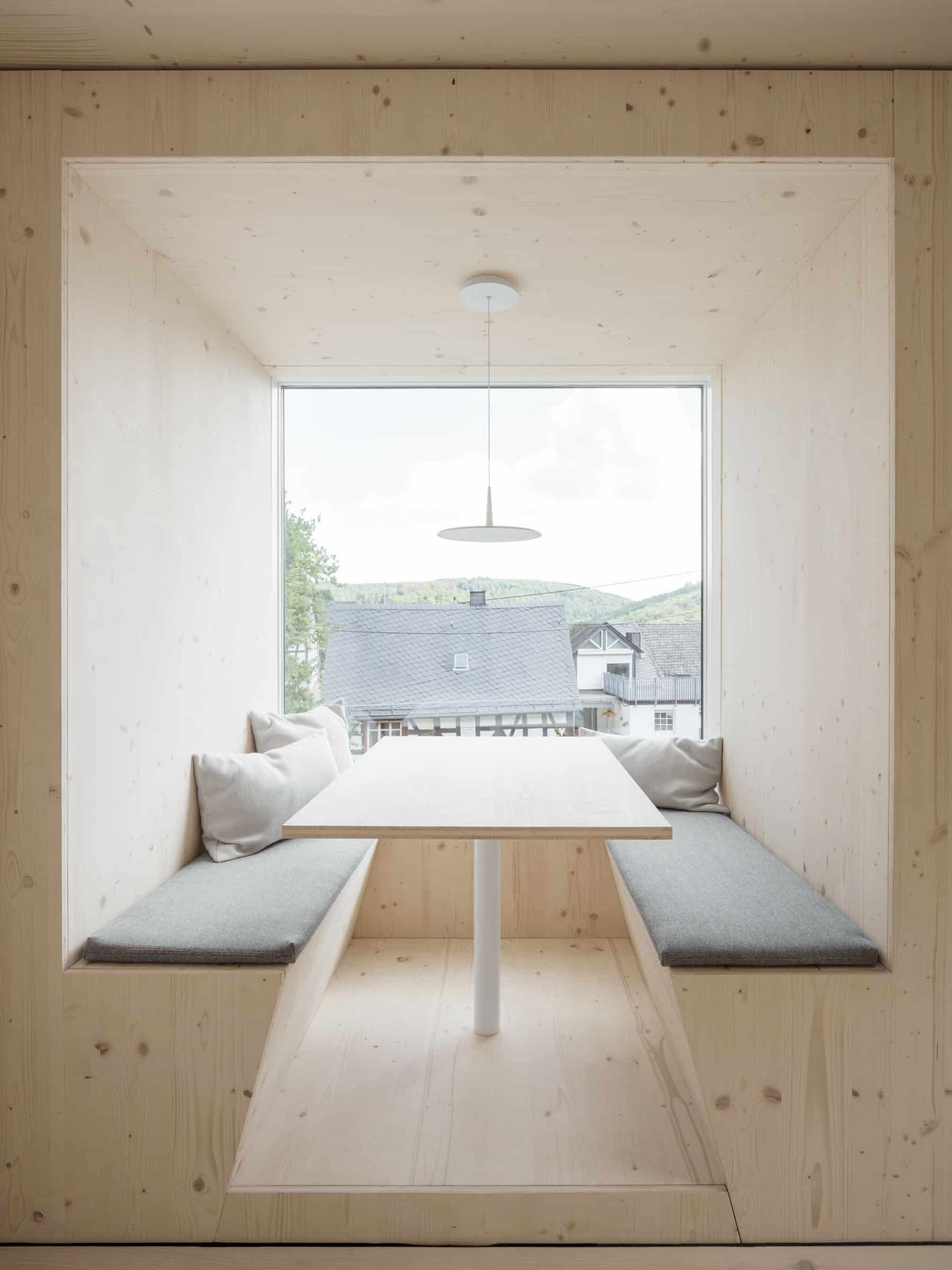
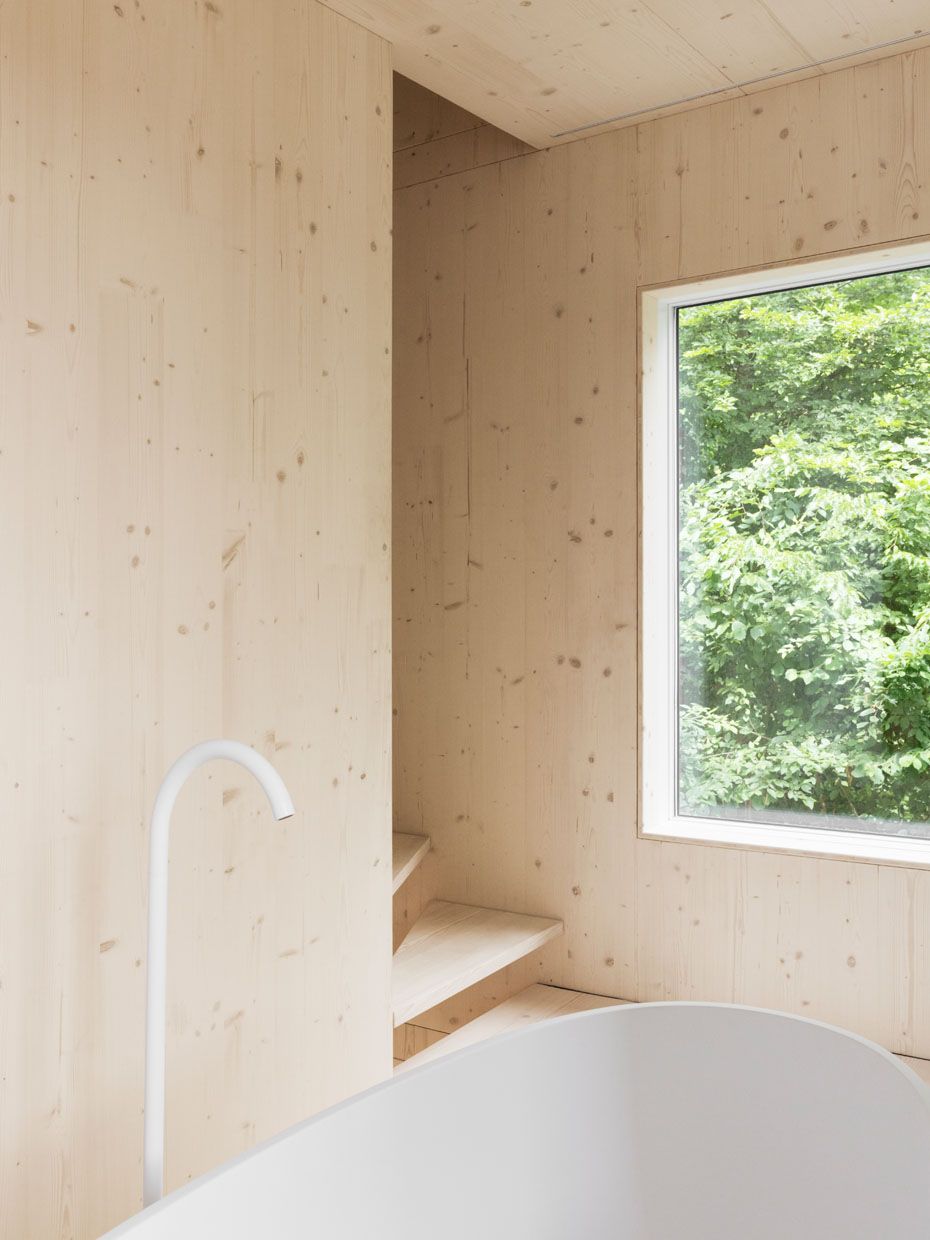
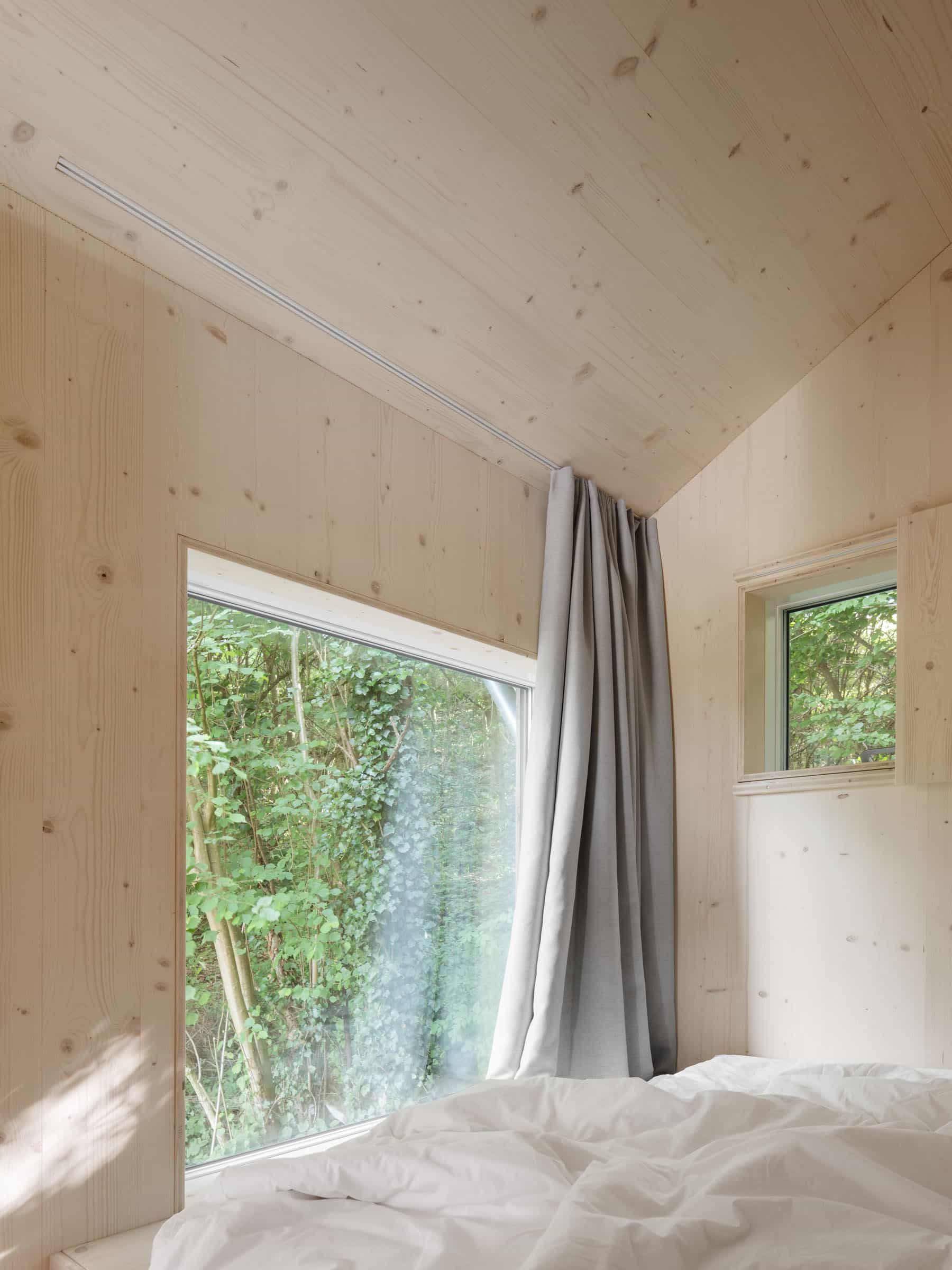
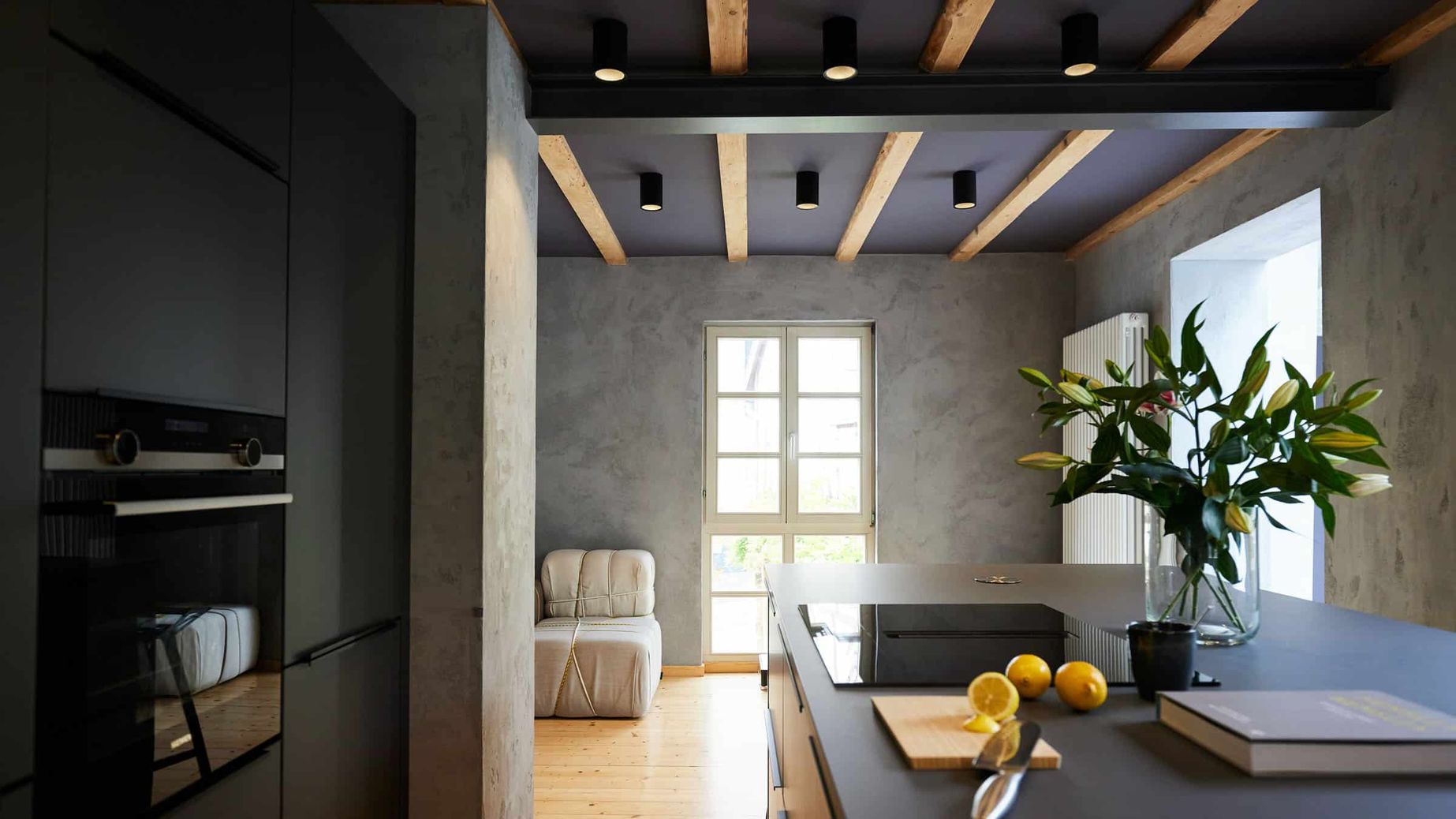
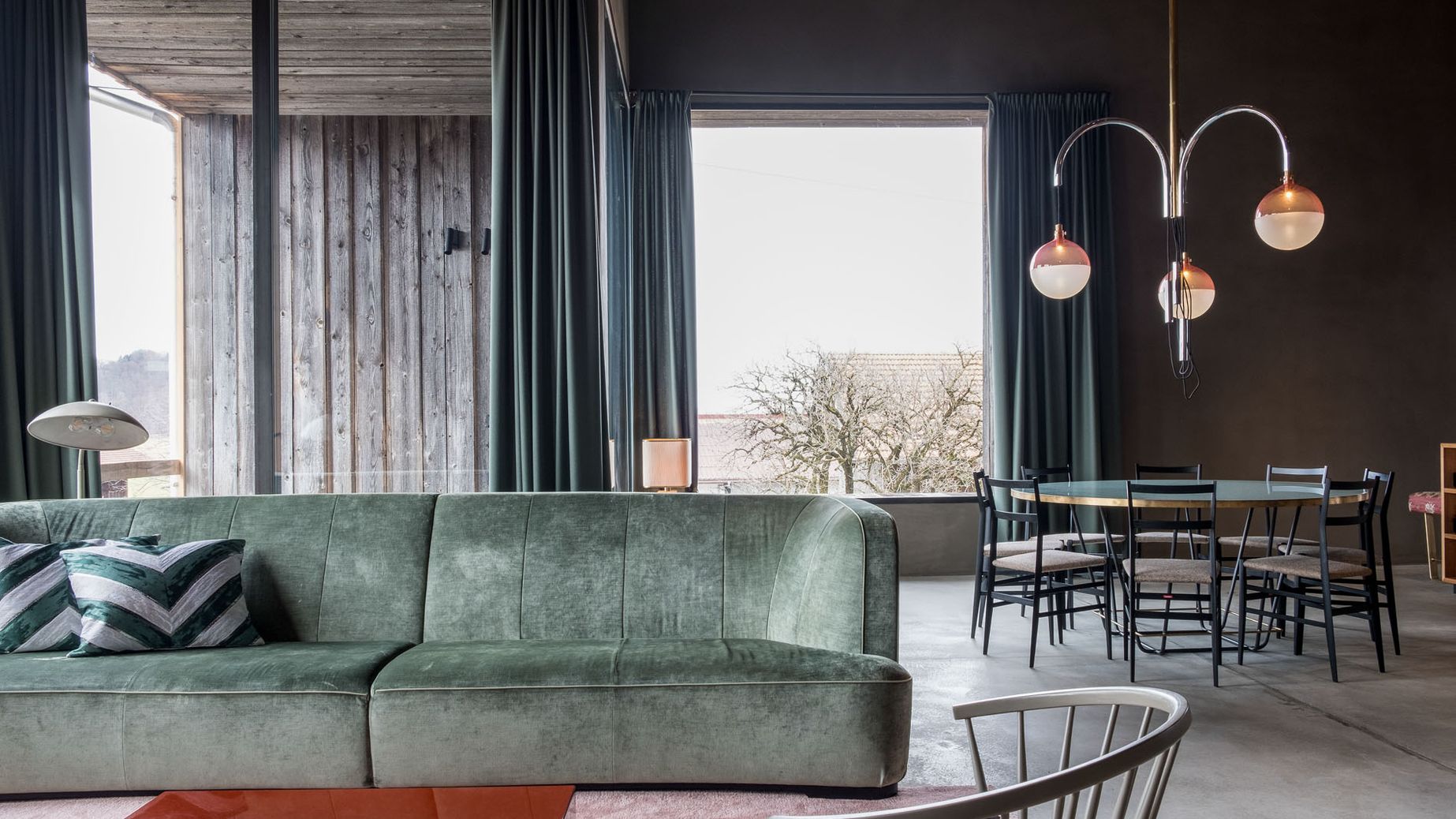
The black and white contrast of the historical half-timbering here is the interplay between inside and outside, which only becomes clear when you enter the bright interiors. Ceilings, walls and the self-designed built-in furniture are all made of light spruce. The scent of fresh wood accompanies visitors outside as they walk across the plain and even inside the house one has the feeling of literally bathing in the forest. The “Gipfelglück”[Peak Bliss ] extends over three floors and the mere 42m2 are arranged in such a way that there is even enough space for a free-standing bathtub. In the “Waldwunder”[Forest Wonder] there is room for up to four people on two floors. And in between in the “Hitzekiste” [Heat Box] is the sauna, which can be used by both houses.
Offline.
Everything that distracts is deliberately dispensed with in the Kleine Bleibe. No pictures on the walls, no television. You automatically look at the view out through the square windows. Nature is the main actor. Walking through the houses, surprising vistas open up. Sometimes you are standing directly in the forest, sometimes you can see the rugged rock formations above the Gelbach valley in the distance. Meanwhile, the sun’s rays dance through the leaves and bathe the rooms in ever-changing light.
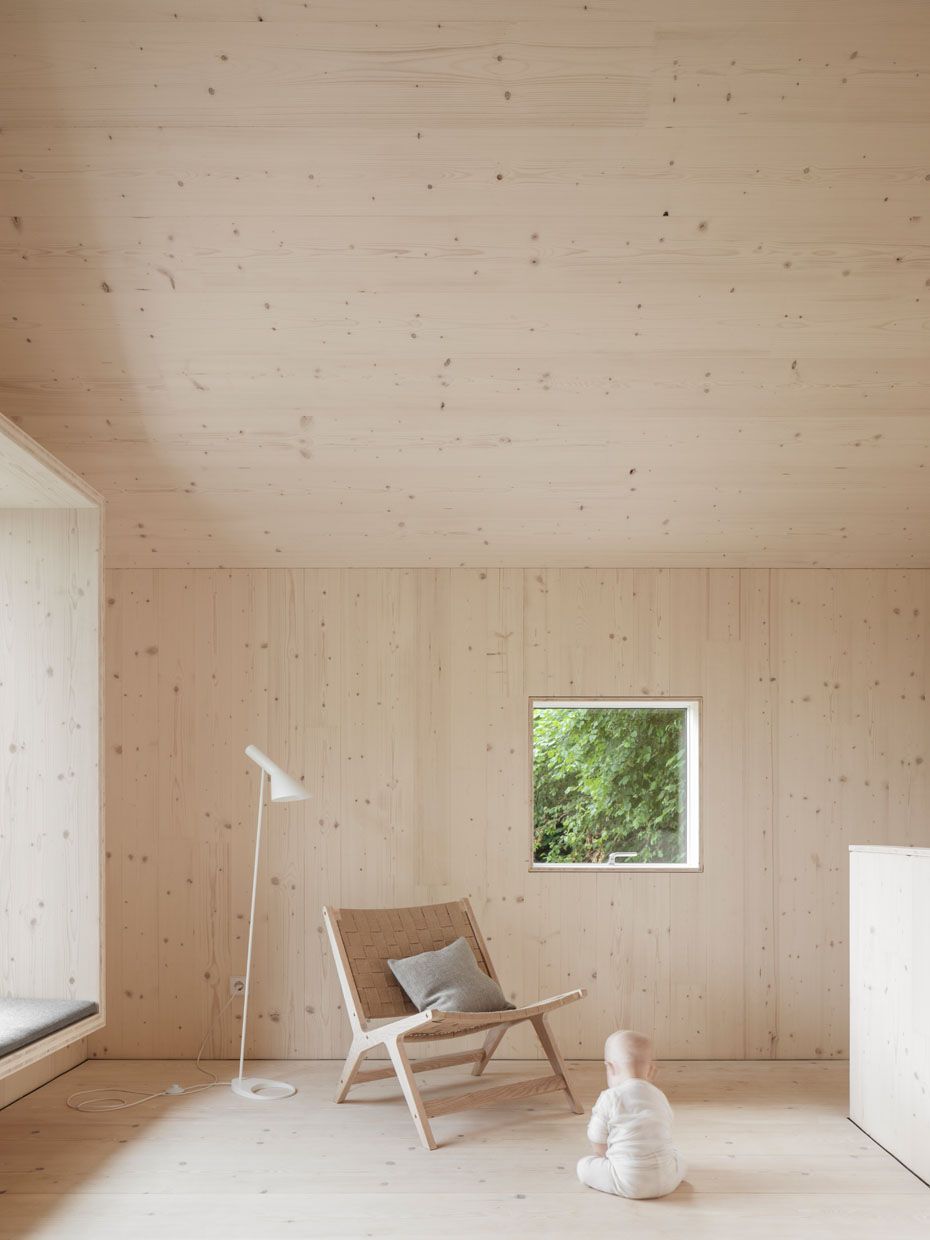
Minimalism is the leitmotif, material reduction, focusing on the essential. “Offline” is written on the front of the guest book, which Caro Fröhlich has lovingly designed, and which is placed on the table for each guest, including a personal greeting. A small work of art that explains the philosophy of the house. Whereas elsewhere there are long instructions for complicated devices, here it is rather the request to switch off everything that disturbs and burdens. Being offline is easy in the Kleine Bleibe. There are no complicated and beeping devices. And the Wi-Fi can be switched off if necessary.
With their concept, the hosts challenge their guests a little. Those who want to drink coffee first have to grind it with the hand mill. And those guests who wash every cup by hand – there is no dishwasher and no kettle – will think about whether they should simply continue to use the cup. “Nudging” is the name of this method of questioning habits and routines in such a pleasant way that it doesn’t even occur to guests that they are missing something. In this way, the Kleine Bleibe redefines terms like luxury and comfort in a very unspectacular way.
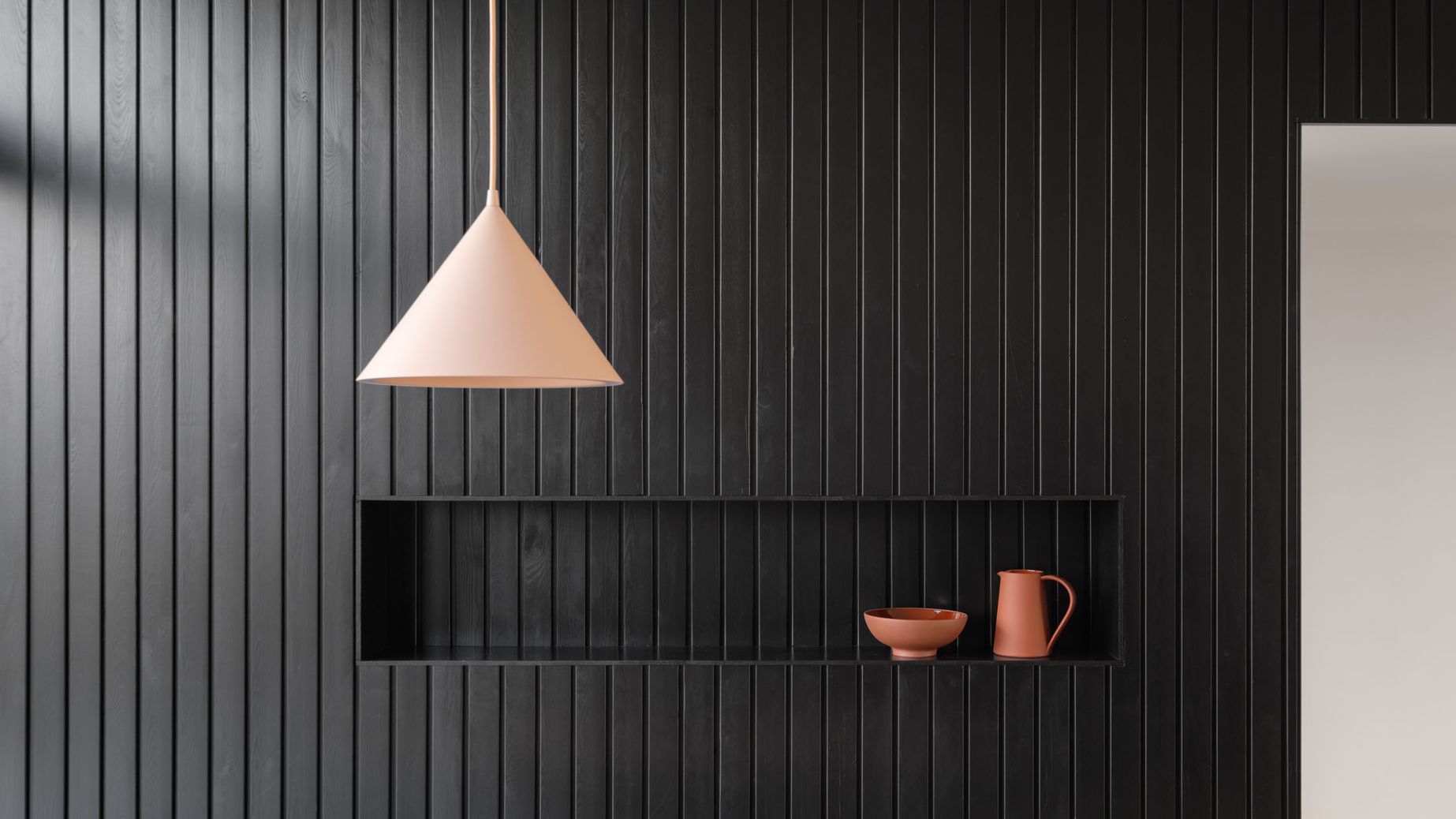
This is also due to the fact that the hosts have chosen the objects for the apartments very consciously. Everyday things that are taken for granted are given special attention. For example, the tableware is made of Westerwald clay and reminds us that Europe’s largest and highest-quality clay deposits are located nearby.
A chance Instagram contact brought Caro Fröhlich and a ceramic artist from Frankfurt together; now plates and cups from a Westerwald ceramic manufacturer are on the shelves. The handmade individual pieces demonstrate the desire to offer guests something special. Unique regional items, things that are not interchangeable, that belong exactly in this place. Even washing up becomes an experience. Holistic – a term used far too often, but at the Kleine Bleibe it hits the spot.
An in the end, you are amazed at how happy you can be with so little.
Text: Anke Frey
Photos: © Célia Uhalde
This article first appeared in our book publication Places & Visions.
0 Comments